Your Cart is Empty

JUNE BOXES SOLD OUT - ORDER NOW FOR JULY CLUB DELIVERY
JUNE BOXES SOLD OUT - ORDER NOW FOR JULY CLUB DELIVERY
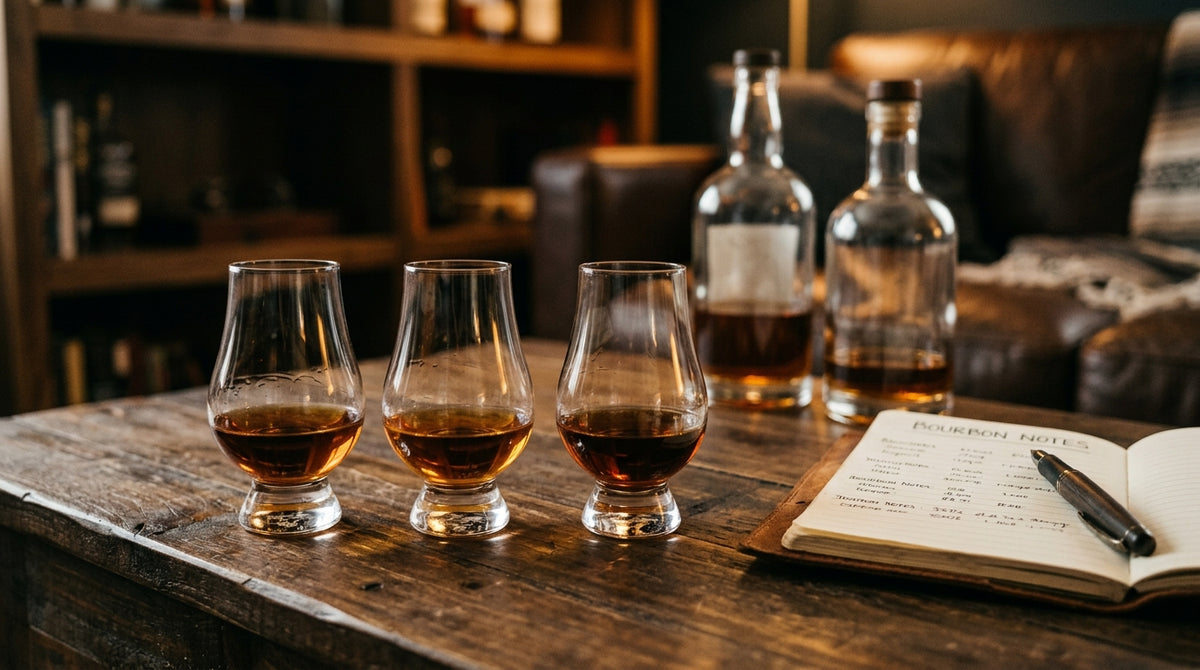
The phrase "bourbon tasting club" covers a lot of ground. It can mean a group of six guys meeting at a friend's house once a month to open three bottles and compare notes. It can mean a formal society that runs distillery visits and private barrel picks. It can mean a nationwide subscription that ships curated bottles to your door every month. All three count. None of them are the same thing.
This piece is a plain-English look at how bourbon tasting clubs actually work, how the category evolved from private groups to consumer-facing subscriptions, and what's worth paying attention to if you're thinking about joining one.
Long before anyone shipped bottles in a cardboard box, bourbon tasting clubs meant something social. A handful of people who liked bourbon, a rotating host, and a rule: everyone brings a bottle, nobody tells anyone what they brought until after the tasting. Blind pours. Honest reactions. The best groups kept notes and pooled them over years.
Those clubs still exist, and they're still the most rewarding version of the concept if you can find one. The social pressure of pouring a $300 allocated bottle and watching someone prefer a $35 shelf pick is a hard correction on the idea that price predicts quality. Home tasting clubs teach you more about bourbon than most formal education will, because they force you to taste without knowing what's in the glass.
If you want to start one: six people is the sweet spot. Three bottles per session (any more and the palate fades). One host per meeting. A shared tasting-note document. That's the whole infrastructure.
As bourbon's popularity climbed through the 2010s, a second layer emerged. Individual distilleries and liquor stores started running their own societies — programs where members paid an annual fee in exchange for access to private barrel picks, limited releases, and distillery events. Four Roses has one. Heaven Hill has one. Michter's runs private tastings. Most major liquor stores with a serious bourbon program have their own version.
These societies sit closer to the marketing end of the spectrum. They're real — you do get access to things the general public doesn't — but they're also specifically designed to keep you buying from one distillery or one store. The distillery society won't recommend a bottle from a competitor, even if that competitor made something better that year.
If you're already loyal to one distillery and drink enough of their product to justify the annual fee, these can be a good deal. If you're trying to build range across the category, they're limiting by design.
The subscription-style bourbon club emerged in the early 2010s and hit mainstream around 2016. The model: you pay monthly (or prepay for three, six, or 12 months), and in exchange, curated bottles show up at your door. Some clubs ship full-size bottles. Some ship sample vials or tasting flights. Some focus on bourbon specifically. Some cover all spirits.
The appeal is straightforward. Most liquor stores stock what sells in their zip code — which means a few dozen labels, mostly big-name producers, mostly the same stock as every other store. A curated subscription covers a different range. You get bottles from small distilleries that don't have distribution in your state. You get finished bourbons, bottled-in-bond releases, store picks, and allocated selections that a local shop would never stock. The club is doing the hunting for you.
The downsides, honestly: not every club is worth the money. A lot of them ship small sample vials instead of real bottles, which turns the experience into a flight instead of a bottle. Some over-rely on sourced whiskey — bourbon bought in bulk from a big producer (often MGP in Indiana) and rebranded under a smaller name. That's not inherently bad, but you want to know what's in the box.
If you're evaluating a bourbon subscription, a few questions matter.
Full-size bottles or sample vials? A full 750ml bottle is a different product than a 50ml sample. A bottle lets you actually live with a whiskey — open it, pour it over several nights, share it with a friend, see how it changes with air. Sample vials are a tasting flight. Useful for variety, less useful for actually getting to know a whiskey.
How is the selection actually made? The best clubs have a human team that tastes through releases every month and makes opinionated picks. Worst case is algorithmic, which usually means "whatever the distributor is promoting this quarter." Opinionated curation is what you're paying for.
What do they send besides the bottle? Context matters. A tasting note card, a distillery profile, a pairing suggestion — these turn a bottle into an experience. Without that context, a subscription is just a shipping company.
How are the tiers structured? Most clubs offer multiple levels at different price points. The right one depends on how deep you already are. If you're mostly drinking shelf bourbons and want to expand, the middle tier is usually the move. If you're already chasing allocated bottles, a top-shelf tier earns its price.
Does it auto-renew, or is it prepaid? For a personal subscription, auto-renew is fine. For a gift, prepaid plans that end when they end are better — no surprise charge on someone else's card six months in.
Underneath all three versions of "bourbon tasting club" — the home group, the distillery society, the subscription — is a common problem. Bourbon in 2026 is an overwhelming category. There are more bottles in more styles at more price points than any one person can track. The local liquor store covers maybe five percent of what's worth drinking. Reviews online are noisy. Allocation makes some bottles impossible to find at retail.
A tasting club — in any form — solves that problem by pooling attention. A home group pools six people's tastings. A distillery society pools the output of one distillery's private program. A subscription club pools a curation team's monthly hunt across the whole category. In every case, the payoff is the same: you get to drink better than you'd manage on your own, because someone else is doing the work of filtering.
A few specific shifts worth knowing about.
Education is getting more serious. Early subscription clubs shipped bottles with light marketing copy. The category has matured. The better clubs now ship real tasting notes, distillery profiles, pairing suggestions, and historical context. That education is often the most valuable part of the subscription — more than the specific bottle in any given month.
Gift-giving has become a primary use case. Most bourbon subscriptions now offer prepaid, non-renewing gift plans — because a subscription gift that auto-charges someone's credit card six months later is a bad gift. The category has figured that out.
Breadth is beating depth. Clubs that started bourbon-only have expanded into whiskey, scotch, tequila, mezcal, and rum. The reason: most serious spirits drinkers eventually get curious outside their category. A bourbon enthusiast will want to try a peated scotch sooner or later. A subscription that only covers bourbon leaves that curiosity unserved.
The secondary market has cooled, and clubs benefit. As we covered in our 2026 bourbon trends piece, allocated prices are coming back to earth. That makes curated subscriptions a better value than they've been in years — you're more likely to get an actually-allocated bottle at fair retail price from a curation team than from secondary hunting.
If you've never joined one, here's the honest breakdown.
Start a home tasting group. If you have five friends who like bourbon, this is the cheapest and most rewarding version. Nothing replaces pouring blind next to people whose reactions you trust.
Join a distillery or retailer society if you're already loyal. If you drink a lot of Four Roses, or your local shop runs serious barrel picks, the annual fee will pay for itself in access.
Consider a subscription club if you want range. If you're trying to build out your palate across the bourbon category — or beyond it — a curated subscription does work you can't easily do yourself. Especially if your local liquor store has limited selection.
Our own take, for what it's worth: the three versions aren't competing. They're complementary. The home group sharpens your palate. The distillery society deepens your knowledge of one producer. The subscription broadens your range across the category. A serious bourbon drinker eventually finds themselves in all three.
If you want to understand what's on the shelf worth drinking, our best bourbon brands guide has the full list across price tiers. For the state of the category, 2026 bourbon trends covers what's shifting. And if you're wondering what separates small-distillery bourbon from the big-four Kentucky majors, the small-distillery piece gets into it.
If you want to see how our own subscription works — tiers, what ships, and how the curation happens — here's the full breakdown.
A bourbon tasting club is any structure that pools attention on what's worth drinking. Home group, distillery society, or subscription — they solve the same problem from different angles. The right one depends on what you're trying to learn and how much work you want to do yourself. The wrong one is the one that ships sample vials and calls it curation.
Copyright Pourmore, Inc. 2026
*If you have a shipping issue or delay please do not hesitate to reach out and we will do our best to address the issue.
States we cannot ship to:
AK, UT, MI
This is a subscription service, all orders (except prepaid gifts) by default renew. Just e-mail us at any questions Contact@Pourmore.com
Orders do not arrive in the wooden box seen in some graphic displays.
PourMore relies upon a network of third party retailers, vendors, distributors, and couriers. When an order is placed it is placed with a licensed third party who fulfills the order. At no time does PourMore take title to, possession of, or inventory related to any order placed on pourmore.com. We are not a retailer.
Copyright Pourmore, Inc. 2026
*If you have a shipping issue or delay please do not hesitate to reach out and we will do our best to address the issue.