Your Cart is Empty

OCTOBER BOXES SOLD OUT - ORDER NOW FOR NOVEMBER CLUB DELIVERY
OCTOBER BOXES SOLD OUT - ORDER NOW FOR NOVEMBER CLUB DELIVERY

The corporate whiskey gift has a specific problem most other gifts don't. It needs to land as personal, but it usually has to scale — five gifts for the partner track, twenty for the year-end client list, a hundred for the all-hands appreciation event. The tension between "personal" and "scalable" is what makes most corporate whiskey gifts feel like checked boxes. They arrive in identical custom-branded boxes, with identical custom-labeled bottles, and they end up on the same handful of credenzas across the recipient list.
This guide is for whoever's responsible for the corporate whiskey gift program at a company that wants the gift to actually do work. The structure: what the recipient probably already has, what scales without going generic, and the prepaid plan that consistently outperforms the custom-labeled bottle approach.
The default move is a custom-labeled bottle of mid-shelf bourbon in a wooden box with the company logo etched onto the lid. The math on this gift is straightforward — the bottle costs $35, the custom label costs $5, the wooden box costs $25, and the recipient ends up with a bottle they could have bought for $35 sitting in a box they don't need.
The recipient is polite about it. They open the bottle, pour one, slide it to the back of the credenza, and the wooden box ends up in the donation pile by spring. The gift was technically a gift. It didn't land.
Most corporate whiskey gifts go to clients and colleagues who are senior enough to buy their own bourbon. They've been drinking whiskey for years. They've worked through the obvious bottles. The bottle in the custom-branded box is statistically one they've already had — Buffalo Trace, Maker's Mark, Woodford Reserve, Glenfiddich 12, Macallan 12. The customization adds nothing to the bottle. It adds friction to the gift, because now the bottle feels like a vehicle for the logo, not a gift.
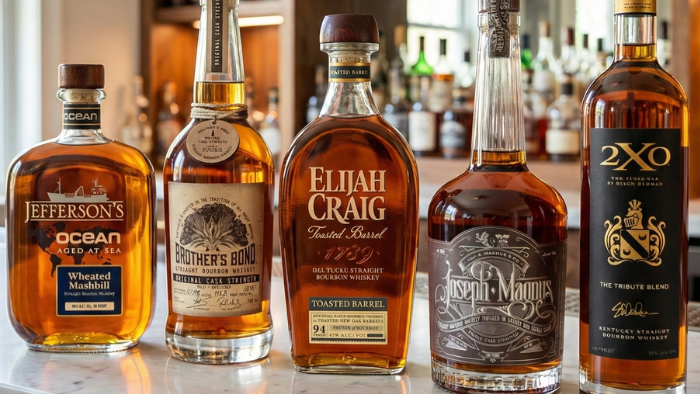
A monthly bourbon or whiskey club subscription does the opposite of the custom-labeled-bottle move. Instead of one bottle the recipient probably has, it sends a series of hand-selected bottles they probably don't have. The Bourbon-of-the-Month Club sends a full 750ml bottle every month — selected by a team that tastes bourbon for a living. Not a sample vial. Not a flight of nips. A real bottle, with notes on what it drinks like and why it's worth pouring.
For a corporate gift specifically, the subscription scales without going generic. Twenty recipients each get a different bottle every month, picked by humans who taste this stuff for a living. The recipient experience is "this company sent me a really thoughtful gift that keeps showing up," which is what most corporate gifting programs are actually trying to produce.
For corporate gifts, the prepaid plan structure solves the accounting and the recipient experience at the same time. The 12-month prepaid gift plans are paid in full at the time of gifting — which means the expense lands cleanly in the fiscal year the gift was given, not spread across twelve months of small charges. They also don't auto-renew, so there's no follow-up account-management work and no risk of the recipient seeing a surprise charge a year later.
Plan lengths can match the relationship. A 3-month plan ($150–$200 budget) works for a client thank-you gift or a moderately senior employee recognition. A 6-month plan ($300–$400) works for major-client gifting and senior-level recognition. A 12-month plan ($600–$900) works for partner-track gifts, board members, or top-tier client appreciation.
The tier choice matters more for corporate gifts than for personal ones, because the gift needs to read as deliberate, not random. Intro works for client gifts where you want the gift to feel generous without overcommitting — the bottles are approachable, well-made, and recognizable.
Explorer is the default for most corporate gifts. Limited runs and single-barrel picks at a tier where the bottles consistently land as "I haven't seen that before" — which is the recipient reaction the gift is trying to produce. Single barrel means every bottle came from one specific barrel, with no blending between them.
Enthusiast is for the top-tier gift — the client who just signed the multi-year contract, the board member at the milestone meeting. Allocated bottles and rare finds. The how it works page walks through the tier breakdown.
Whiskey gifts have shipping constraints that other gifts don't. The recipient has to be 21 or over. Some states don't allow direct-to-consumer alcohol shipments at all. A few states require adult-signature delivery only. The gift page covers the state-by-state shipping availability — anything ordered to a restricted state needs a workaround (alternate shipping address, in-state distribution, etc.) before the gift is set up.
For a corporate gift program, it's worth pulling the recipient address list before the order and cross-referencing shipping eligibility. A gift that doesn't arrive is worse than a gift that doesn't land.
The custom-label bottle exists because corporate gift-givers want some personal touch. The good news is that the personal touch doesn't have to be the bottle itself. A handwritten note from the executive sponsor of the gift, addressed to the recipient by name, sent alongside the first month's bottle, does more work than a custom label on the bottle ever did. The note can reference the relationship — "thanks for the partnership on the Q3 launch, here's a bottle a month for the next year" — in a way a generic custom label can't.
The card costs nothing. It outperforms every custom-bottle program at any scale.
A few specific moves to avoid. The custom-labeled bottle approach, for the reasons above. A whiskey-themed gift basket with a small bottle and a lot of branded filler — coasters with the logo, custom Glencairns with the logo, a tasting journal with the logo — that reads as a corporate swag drop rather than a gift. A novelty decanter shaped like a state outline or a barrel that ends up in a closet by month two. Any gift where the company branding is more prominent than the bottle inside.
The simplest version of the corporate gift consistently outperforms the most elaborate one. A real bottle (or a real plan), a real card from a real person at the company, and respect for the recipient's time. That's the whole formula.
Three practical notes for running this at scale. First, recipient address quality matters more than for normal gifting — pull the list, verify, and check shipping eligibility before placing the orders. Second, timing matters — corporate whiskey gifts tend to land best when they arrive a few weeks before a major business moment (year-end, contract renewal, anniversary of the relationship) rather than tied to a calendar holiday everyone else is also gifting around. Third, the unboxing experience matters — a subscription that arrives in a clean, simple box that doesn't scream "marketing" lands better than a box that does.
The custom-labeled bottle is the default corporate whiskey gift, and it's the version that lands the softest. The prepaid subscription plan is the version that scales without going generic — different bottles for every recipient, picked by people who taste for a living, arriving for the duration of the plan, with a handwritten card from the executive sponsor doing the personal-touch work that the custom label was trying to do.
If you want to see the gift options laid out in one place, the gift page takes about 90 seconds and walks through the program structure. For a corporate gift program that's trying to land as thoughtful rather than transactional, the subscription play is the move. The card is the part that turns the program from a checked box into a real gift.
Copyright Pourmore, Inc. 2026
*If you have a shipping issue or delay please do not hesitate to reach out and we will do our best to address the issue.
States we cannot ship to:
AK, AR, HI, MI, MS, MT, UT
This is a subscription service, all orders (except prepaid gifts) by default renew. Just e-mail us at any questions Contact@Pourmore.com
Orders do not arrive in the wooden box seen in some graphic displays.
PourMore relies upon a network of third party retailers, vendors, distributors, and couriers. When an order is placed it is placed with a licensed third party who fulfills the order. At no time does PourMore take title to, possession of, or inventory related to any order placed on pourmore.com. We are not a retailer.
Copyright Pourmore, Inc. 2026
*If you have a shipping issue or delay please do not hesitate to reach out and we will do our best to address the issue.