Your Cart is Empty

OCTOBER BOXES SOLD OUT - ORDER NOW FOR NOVEMBER CLUB DELIVERY
OCTOBER BOXES SOLD OUT - ORDER NOW FOR NOVEMBER CLUB DELIVERY
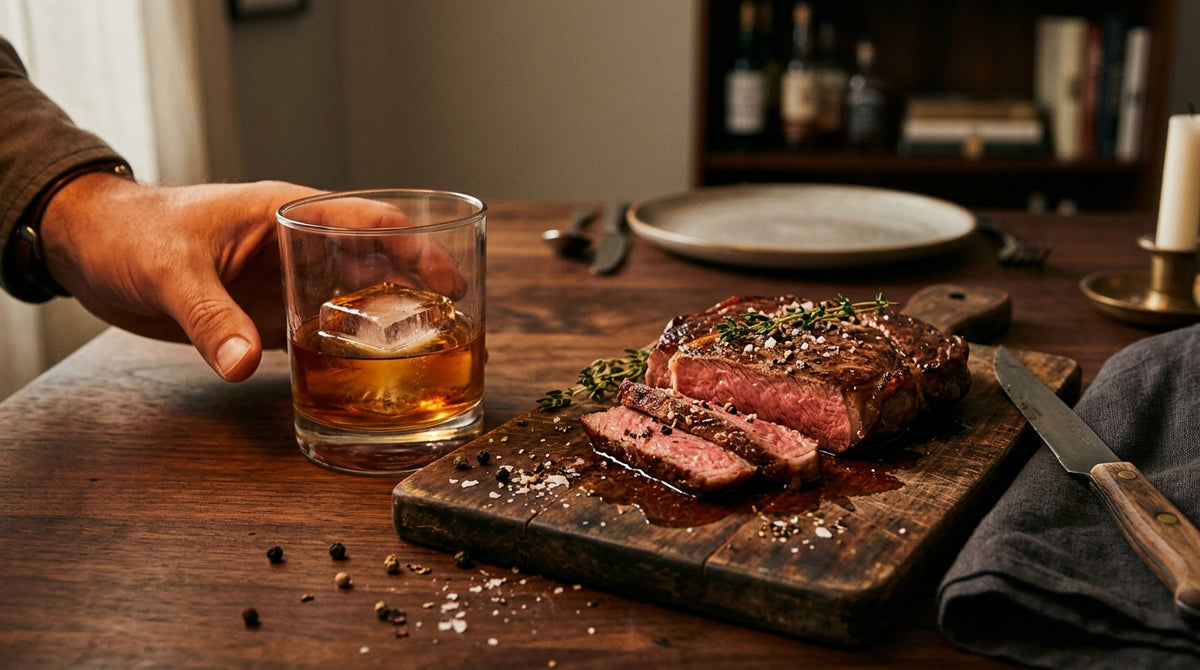
A good steak deserves better than whatever whiskey is closest to the fridge. The pairing is real — the Maillard crust on a seared steak shares a chemical family with the caramelized sugars in an oak-aged whiskey, which is why they recognize each other at the table. But the category called "whiskey" contains a wild range: wheated bourbon at 90 proof, 120-proof single-barrel rye, 10-year Islay scotch. Different whiskies match different cuts, and the wrong pairing makes both worse.
Here's how to match whiskey to steak, cut by cut, with the reasoning behind each call so you can improvise with whatever's on your own shelf.
Ribeye is the fattiest, most richly marbled of the popular cuts. The fat is the whole point — it bastes the meat as it cooks and leaves the mouth coated after every bite. That fat needs a whiskey with enough structure to cut through it, and enough flavor concentration to match the richness.
The answer is a high-rye bourbon. A mash bill (the recipe of grains) that carries more than 10% rye brings pepper and spice, which slices through the ribeye's fat the way black pepper does. The caramel notes from the barrel meet the caramelized crust on the steak. And the proof — something between 90 and 110 — gives it the backbone to hold up.
Pour: Wild Turkey 101, Four Roses Single Barrel, Bulleit Bourbon, or Russell's Reserve Single Barrel.
Skip: anything below 90 proof (gets lost), anything wheated (too soft for the fat), anything over 120 proof (overwhelms).
Filet is the leanest popular cut. Barely any fat, tender texture, mild flavor. A ribeye-pairing whiskey would trample it. What filet needs is something softer and more fragrant — a whiskey that adds flavor without dominating.
This is where a wheated bourbon earns its place. Wheated means wheat replaces rye as the secondary grain. The result drinks softer, sweeter, with more vanilla and less pepper. Poured next to a filet, it brings the flavor the cut lacks without bullying the texture. An Irish whiskey — typically triple-distilled, often smoother and lighter than bourbon — works the same way.
Pour: Maker's Mark 46, Weller Special Reserve, Larceny, or Redbreast 12 (Irish).
Skip: anything barrel proof, anything heavily peated, high-rye.
Strip sits between ribeye and filet in fat content and texture. It's substantial but not overwhelming, beefy but not dripping. The pairing wants to sit in the middle too — a standard bourbon at moderate proof, neither soft nor aggressive.
Buffalo Trace is the answer here, or something at a similar proof and profile. Balanced, caramel-forward, no single note dominant. Elijah Craig Small Batch does the same job at a similar price. The pairing isn't spectacular. It's correct. Strip doesn't ask for spectacular — it asks for something that lets the meat be the star.
Pour: Buffalo Trace, Elijah Craig Small Batch, Woodford Reserve, or a standard Knob Creek.
A porterhouse is effectively a strip and a filet separated by a bone. Which means the ideal pairing would be two whiskies — a wheated bourbon for the filet side, a standard bourbon for the strip. If you're only pouring one, split the difference. A standard Kentucky bourbon at 90–95 proof handles both sides without being wrong on either.
The better move, if you're hosting, is to pour both. Start with the wheated when cutting from the filet side. Switch when the strip side gets interesting. It sounds fussy. It is. But the difference is real.
Pour: Buffalo Trace solo, or Maker's 46 + Four Roses Small Batch if you want to split it.
Skirt and flank are lean, muscular, grill-over-high-heat cuts. Hanger is the closest-to-offal of the "butcher's cuts" and carries a deeper iron flavor. All three take well to marinade, char, and serious heat. The pairing should match.
This is where a barrel-proof bourbon or a peated scotch earns its keep. Both bring a weight of flavor that keeps up with the grilled char. Barrel proof (meaning no water added after the barrel, usually 110–130 proof) adds oak concentration. Peated scotch — like Laphroaig 10 or Lagavulin 16 — brings actual smoke from malt that was dried over peat fires. Either one talks to the grill marks.
Pour: Elijah Craig Barrel Proof, Stagg Jr., Laphroaig 10, or Lagavulin 16.
Skip: anything below 95 proof. Too light for the char.
A tomahawk is a ribeye with the full bone left on. A cowboy cut is similar, slightly smaller. Both are theater. Both are massive. A 40-ounce cut of beef needs a pour with equal presence.
The answer is a long-aged, high-proof bourbon. Something that's spent 10+ years in oak, bottled at barrel proof or close to it. The extra age brings dried-fruit and tobacco notes that pair beautifully with deeply charred beef. The high proof provides structure. The pairing is a matched pair of statement pieces.
Pour: Knob Creek 12, Russell's Reserve 13 Single Barrel, Elijah Craig Barrel Proof.
Steak au poivre — pan-seared filet crusted with crushed peppercorns, finished in a cognac-cream sauce — has been built for rye whiskey and nobody talks about it. 100% rye whiskey (meaning the mash bill is all rye, no corn) brings an aggressive black-pepper profile that echoes the peppercorn crust. The cream in the sauce softens the edges. Both rye and cognac have dried-fruit and oak notes that overlap.
Pour: Pikesville Rye (110 proof, old-school), Willett Family Estate Rye, or Sazerac Rye.
Single malt scotch is a different conversation. Non-peated scotch (Speyside-style, like Glenlivet, Glenfiddich, Aberlour) works with most steaks the way bourbon does — think sherry-finished notes matching a well-seared crust. Peated scotch (Islay-style) only works with cuts that can stand up to the smoke: hanger, skirt, or anything aggressively charred.
If you're bringing scotch to a steak dinner and want to play it safe, pour a sherry-cask-aged Speyside. GlenDronach 12 or Aberlour A'bunadh both earn the spot. If you want drama, pour Lagavulin 16 alongside a skirt steak cooked over open flame. The conversation between peat and smoke will do the work.
A few practical notes that make a noticeable difference.
If you pull back from specific bottles and specific cuts, three principles cover almost every whiskey-and-steak pairing:
Match the fat. More fat in the cut wants more structure in the whiskey — higher proof, more rye spice, more oak.
Match the char. A grilled, heavily seared, or smoked cut calls for a whiskey that has its own heat — barrel-proof bourbon, or peated scotch.
Respect the delicate cuts. Filet and similar lean cuts want a softer whiskey that adds flavor rather than competing.
Those three rules will get you through any steak-and-whiskey situation, even if the specific bottle you have isn't on this list.
If you want to understand why some of these high-proof pairings hit harder than the standard-proof ones, our high-proof bourbon guide covers what water does (and doesn't do) to flavor. For a broader view of whiskey-and-food logic outside of steak, the whiskey food pairings piece is the companion. And for specific bottle recommendations across the bourbon shelf, the best bourbon brands guide has the list.
Whiskey and steak isn't a single pairing — it's a dozen, depending on the cut and the bottle. Ribeye wants high-rye. Filet wants wheated. Grilled cuts want barrel proof or peat. The common thread: match the intensity, respect the fat, and let the first bite happen before the first sip. Do that and the pairing earns its reputation.
If you'd like interesting bottles showing up at your door to try against whatever's on the grill, here's how the club works.
Copyright Pourmore, Inc. 2026
*If you have a shipping issue or delay please do not hesitate to reach out and we will do our best to address the issue.
States we cannot ship to:
AK, AR, HI, MI, MS, MT, UT
This is a subscription service, all orders (except prepaid gifts) by default renew. Just e-mail us at any questions Contact@Pourmore.com
Orders do not arrive in the wooden box seen in some graphic displays.
PourMore relies upon a network of third party retailers, vendors, distributors, and couriers. When an order is placed it is placed with a licensed third party who fulfills the order. At no time does PourMore take title to, possession of, or inventory related to any order placed on pourmore.com. We are not a retailer.
Copyright Pourmore, Inc. 2026
*If you have a shipping issue or delay please do not hesitate to reach out and we will do our best to address the issue.