Your Cart is Empty

OCTOBER BOXES SOLD OUT - ORDER NOW FOR NOVEMBER CLUB DELIVERY
OCTOBER BOXES SOLD OUT - ORDER NOW FOR NOVEMBER CLUB DELIVERY

For the first time in more than a decade, the bourbon market isn't climbing in one direction. Allocated prices are softening. New distilleries are landing actual distribution. And the drinker who would have paid $400 for a Stagg on secondary in 2022 is asking whether the bottle is worth $90 at shelf. That's a healthy correction, and it's changing what's worth paying attention to.
Here's what's actually moving in bourbon heading into 2026 — what's rising, what's fading, and what it means for what you pour.
For about five years, the secondary market for allocated bourbon — Pappy Van Winkle, George T. Stagg, Weller 12, Eagle Rare 17 — climbed to a level that didn't track with what was in the bottle. A lot of that was investment behavior: collectors buying to flip, not to drink. Through 2024 and into 2025, those prices finally started to come down. Not dramatically. But enough that "flipping allocated bourbon" stopped being a guaranteed money-maker.
What's behind it: fewer new collectors entering, more supply as distilleries caught up with pandemic-era demand, and a broader realization that paying $500 for a bottle of bourbon the distillery sold for $80 is an expensive way to drink. The bottles are still hard to find at retail. They're just not the trophy they were in 2022.
What it means for you: if you were chasing allocation prices on the secondary market, stop. There are bottles at $60 that drink as well as the $500 bottle you were hunting. If you want to know what those bottles are, our best bourbon brands guide has the list.
A wheated bourbon is one where wheat replaces rye as the secondary grain. Corn is still the majority (it has to be at least 51% by law), but the second-most-used grain swaps from rye to wheat. That swap makes the bourbon drink softer, sweeter, and less spicy. Maker's Mark, Weller, Larceny, and Pappy Van Winkle are all wheated.
Wheated bourbon has been climbing in popularity since Pappy went mainstream, and that trend hasn't slowed. What's changed in 2026 is the number of smaller distilleries releasing their own wheated expressions. Wilderness Trail, Woodford Reserve (with their Wheated Bourbon), and several others are putting serious wheated bourbon on shelves under $60 — which means the style is finally accessible without chasing Pappy.
Bottled-in-bond is a century-old legal standard: one distiller, one distilling season, at least four years old, 100 proof, aged in a federally bonded warehouse. In plain English, it's a receipt of integrity. When the law passed in 1897, it was the first consumer-protection standard for whiskey. It basically stopped dying.
It's back. Every small distillery worth paying attention to is releasing a bottled-in-bond expression, and the established brands are following — Heaven Hill, Old Fitzgerald, New Riff, Wilderness Trail, Henry McKenna, and more. The reason: it's a guarantee of quality in a market where "craft" means nothing and "small-batch" means nothing. Four years, 100 proof, one distiller. You can't fake it.
If you see "bottled-in-bond" on a label, the floor is higher than almost anything else you'll buy at that price.
Rye whiskey has been positioned as the cocktail workhorse for years, and the assumption was that bourbon is for sipping and rye is for drinks. That's breaking down. A lot of the most interesting sipping whiskey right now is rye — specifically high-rye and 100% rye expressions from both big distilleries and small producers.
The drivers: the taste calibration that came with bourbon's rise finally caught up to rye. Drinkers who learned to notice caramel, oak, and char in bourbon started tasting the same complexity in well-aged rye, plus the added spice that rye brings. Michter's US*1 Rye, Sazerac Rye, Pikesville, Willett Family Estate Rye, and several MGP-sourced ryes are now landing on serious shelves, not just bar wells.
If you've spent 10 years only drinking bourbon, a good rye is the easiest way to reset your palate.
Finished bourbon is bourbon that's been transferred out of the original new charred oak barrel (required by law for bourbon) into a second barrel that once held something else — port, sherry, rum, cognac, stout beer, maple syrup, you name it. That second barrel adds flavor.
Angel's Envy started this trend 15 years ago with a port finish. It exploded. Now every distillery has a finished line, and the quality is uneven. Some finishes are genuinely interesting. Some are masking young whiskey with a strong second-barrel flavor, which is harder to pull off well.
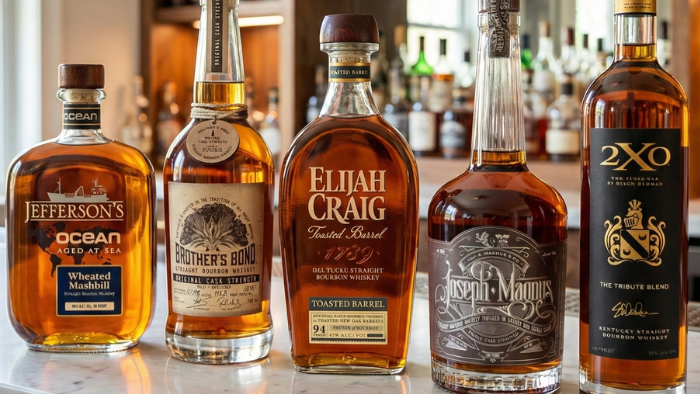
The good ones in 2026: Angel's Envy Port Finish, Blood Oath Pact 11 (an annual release with three different finishing barrels), High West A Midwinter Night's Dram (a rye finished in port barrels), and Jefferson's Ocean (aged on actual ships, which does something weird to the whiskey). The bad ones: anything that tastes more like the finishing barrel than the bourbon. You'll know.
Bourbon was long one of the most male-coded spirits in the business, both in the drinking and the making. That's changing — faster than the trade press has admitted. Marianne Eaves (formerly Castle & Key, now consulting), Victoria MacRae-Samuels (Maker's Mark), Jane Bowie (Maker's Mark), Peggy Noe Stevens (first female Master Bourbon Taster), and Fawn Weaver (Uncle Nearest) are running some of the most interesting programs in American whiskey right now.
What this means: the style of whiskey being made is broader. New mash bills. Different yeast strains. More experimentation with aging and finishing. Uncle Nearest alone has reshaped how Tennessee whiskey is talked about, and it's now one of the fastest-growing premium American whiskey brands in the country.
A store pick is a single barrel that a liquor store (or bar, or restaurant) selects directly from the distillery. Four Roses, Knob Creek, Buffalo Trace, Eagle Rare, Maker's Mark, and several others run store-pick programs. The bottle on the shelf at your local shop might be a single-barrel version of the same whiskey that's five dollars more expensive in the standard release.
These are the best value on the shelf right now — often better than the distillery's flagship, because the store got to taste 10 barrels and pick the best one. If your local shop labels store picks (usually with a neck tag or special label), buy them.
Ready-to-drink cocktails — canned, pre-mixed — used to be junk. The early RTD market was built on syrupy, over-sweetened canned drinks that no self-respecting bar would pour. That's changed. High West, Whistlepig, and Cutwater (among others) are making canned old fashioneds and Manhattans that hold up. Several distilleries now release their own high-end RTDs using the same whiskey they put in bottles.
It's not a replacement for a proper cocktail. But for a cookout or a camping trip, the best RTDs are finally respectable.
A few things the market is moving past:
The takeaway for a bourbon drinker heading into 2026: stop chasing allocation. Start paying attention to bottled-in-bond and small-distillery releases. Try more rye. Look for store picks at your local shop. Be skeptical of anything labeled "craft" or "small-batch" without more specifics (we covered why in our small-distillery bourbon piece). If you want to understand what higher proof actually does to flavor, the high-proof guide is the place.
And if you want the year's interesting bottles sorted for you so you don't have to do the scouting, here's what we're about — we taste hundreds of bottles every year and send the ones that actually earned shelf space.
2026 is the year bourbon stopped being a hype market and started being an interesting one again. The best bottles aren't the hardest to find. The trend worth following isn't allocation — it's integrity. Buy the bottled-in-bond. Try the small distillery. Pick the store pick. Drink the rye. You'll end up with a better shelf than the person hunting Pappy.
Copyright Pourmore, Inc. 2026
*If you have a shipping issue or delay please do not hesitate to reach out and we will do our best to address the issue.
States we cannot ship to:
AK, AR, HI, MI, MS, MT, UT
This is a subscription service, all orders (except prepaid gifts) by default renew. Just e-mail us at any questions Contact@Pourmore.com
Orders do not arrive in the wooden box seen in some graphic displays.
PourMore relies upon a network of third party retailers, vendors, distributors, and couriers. When an order is placed it is placed with a licensed third party who fulfills the order. At no time does PourMore take title to, possession of, or inventory related to any order placed on pourmore.com. We are not a retailer.
Copyright Pourmore, Inc. 2026
*If you have a shipping issue or delay please do not hesitate to reach out and we will do our best to address the issue.