Your Cart is Empty

The Long Pour — PourMore's monthly editorial. Decoded, one bottle at a time. Inaugural piece, May 2026.
By the PourMore editorial team. We hand-select every bottle that goes into our members' boxes, and when we can, we sit down with the people who make them. This piece is one of those sit-downs.
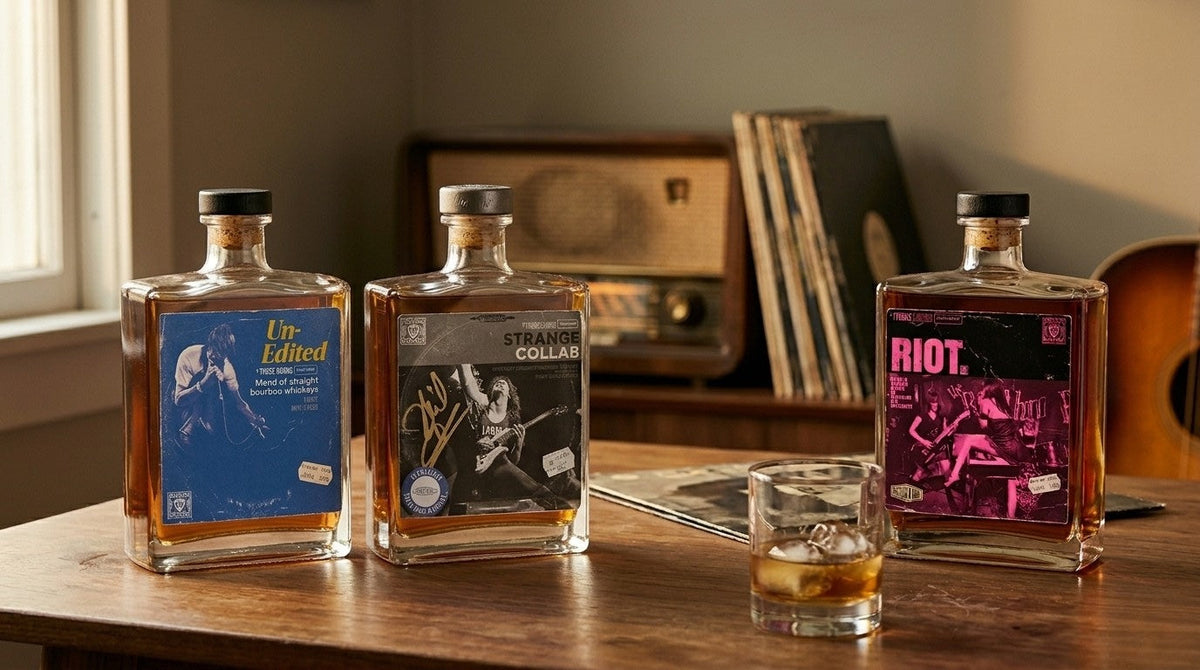
The short version: Three Chord is a sourced bourbon blender that names its sources, a musician-founded brand whose musicians actually blend, the maker of the only double-bonded rye on the shelf, and the brand that just put a bourbon in a square vinyl-record bottle with bright pink on the label. Pick a bourbon-industry default. Three Chord went the other way. Here's what's in the glass across the three bottles shipping in May — Strange, Riot, and Unedited — and why each one is a little argument with the category.
In this piece
Most bourbon brands sit in a box and tend it carefully. Big distillery or small. Sourced or distilled. Crafted by hand or bottled by spreadsheet. Once a brand picks its box, the box does most of the talking.
Three Chord doesn't fit any of the boxes. They blend sourced juice from three different distilleries and brag about it. They built the only double-bonded rye on the shelf by extending a regulatory gray area until it worked. They make whiskey with bands — real bands, in the room, blending barrel samples for as long as it takes. They redesigned their bottles to look like vinyl records, spine-out, on a shelf. And one of their flagship pours started as a fundraiser for a family that lost their son.
Five things, five reasons this is a brand worth understanding before you pour the bottle in your hand.
Three Chord was founded by Neil Giraldo. If the name doesn't land instantly, the résumé will — Grammy-winning rock guitarist, longtime collaborator and husband of Pat Benatar, Rock and Roll Hall of Fame inductee. He didn't start a bourbon brand because someone else told him there was a hole in the market. He started one because he wanted a thing that could throw off money he could put back into causes he cared about.
The blending-as-musicianship metaphor isn't a marketing afterthought. It's the founding logic. Master blender Kars Petersen frames it the same way:
"All the different parts of a chord come together to the whole is greater than the sum of the parts… It's kind of the same idea with our approach to blending whiskey. The finished product is greater than each individual component."
It's a simple idea, and it earns itself: take three distinct components, find the combination that's bigger than any one of them, and bottle that.

Three Chord recently overhauled their packaging. The old bottle was the bourbon-category default — tall, skinny, black-and-gold, the silhouette you can name with your eyes closed because every twelfth bottle on the back bar looks like it. The new design is square, duo-tone, and on the Riot rye expression the label is bright pink on black. You're not going to miss it.
The square silhouette is deliberate. Line the bottles up spine-out on a shelf and they read like records pulled from a sleeve. Kars on the thinking:
"If you were to ask someone who knows their whiskey bottles, name a label that's black and gold, they could list off like dozens. We wanted our product to stand out as much on the shelf as it does in a glass."
"We wanted it to really be like a vinyl record. Square front, square back side… if someone has all the core skew bottles sitting around, they could line them up on the side and pull it out like you're pulling a record out of the sleeve."
"Rye whiskey is scared of pink. They need to get over it."
And that's just the part of the brand you can see from across the bar. Here's what's happening in the bottle.
Three Chord blends from three named distilleries — Wilderness Trail in Kentucky, Bardstown Bourbon Company, and MGP Ingredients in Indiana. They print the names. They talk about them on tours. They walk you through which source contributes which character to which expression.
That sounds like a low bar. In the blending category, it's not. Most blending brands either don't name their sources or imply they distill juice they buy. Kars is direct about why that gets uncomfortable:
"A lot of blending distilleries are pretty secretive. They don't want the perceived shame that used to come with a lot of blending… everyone, not everyone, but a lot of people are doing it, so why feel shame about it, you know?"
A quick history lesson, because the sourcing-shame thing has roots. The boutique-brand era of the early 2010s leaned hard on "craft" as a marketing word, and one of the implications it carried was distillery-of-origin equals better. If you sourced juice and blended it, you were the lesser cousin of the brand that distilled its own. That logic doesn't survive contact with what's actually on the shelf right now — some of the best, most consistent bourbons in the category are sourced and blended by people who are better at picking and combining than they would be at distilling at scale. (Full version of that argument is the standalone piece linked at the bottom.) Three Chord just decided to stop pretending and let the work speak.
This one's worth understanding because it doesn't exist anywhere else.
Bottled-in-Bond is a federal designation written into U.S. law on March 3, 1897. To wear the label, a whiskey has to come from a single distillery, a single distilling season, be aged at least four years in a federally bonded warehouse, and be bottled at exactly 100 proof. Same distillery, same season, same warehouse. It was designed to be a consumer protection against fraud — the government's stamp meant the whiskey was what the label said it was.
Three Chord wanted to make a bonded rye blended from two bonded sources. Read that back to yourself. By the strict letter of the 1897 act, that shouldn't be possible — bonded means one distillery, not a blend across two.
Here's the move. They contracted with Bardstown and MGP to extend each of those distilleries' DSPs — Distilled Spirits Plants, the federal designation for what counts as one bonded facility — to Three Chord's own bonding warehouse. On paper, Three Chord's site counts as part of each source distillery's DSP, which means technically each batch is being bonded at the same facility that made it. Kars:
"We have contracted with both of them to kind of extend their DSPs to our bonding warehouse. So we kind of found some gray area there. So we're sharing their DSP. So we are technically the same facility."
It's a regulatory hack in the engineering sense of the word, and the resulting bottle is — as far as anyone we've found can confirm — the only double-bonded rye on the shelf. Read the 1897 act strictly and it's a stretch. Read it generously and it's exactly the kind of innovation Bottled-in-Bond was supposed to make room for: a consumer-protection designation that says this is real whiskey, made the way the label says it was, by people who'll put their name on the warehouse. Three Chord just stretched the "facility" definition until it covered three buildings instead of one.
That's the production engine. Here's what it makes.
Three Chord ships three expressions to PourMore members in May. Bourbon Intro members get Strange. Whiskey Intro members get Riot. Bourbon Explorer members get Unedited. Each one is a different conversation with the category. Skip to the bottle you're holding, or read all three.
Strange started as a fundraiser. Johnny Strange was a stunt skydiver — reportedly fundraising during the jump that killed him. Three Chord made the bottle as a one-off limited release tied to the cause. People wouldn't let it go.
"We only ever meant for it to be a limited product. And people loved it so much and they kept asking about it… We were like, 'You know what? Why don't we just keep making it?' And we still donate a portion of the proceedings to the Strange Family."
So every bottle still keeps the original mission going. That's not a sticker on the back label — it's a line item, every release.
What's in it. A blend of two Kentucky bourbons — Wilderness Trail and Bardstown Bourbon Company — finished at least three months in pinot noir barrels from Strange Family Vineyard. The combined mash bill comes out to 75% corn, 21% rye, 4% malted barley — a classic-leaning bourbon backbone, finished into something pinot noir actually plays nicely with. Pinot noir cask finishing is genuinely uncommon in bourbon. Most brands lean on heavier finishes — sherry, port, rum — because, in Kars's words, pinot noir is "tough to get to not be so in your face and overwhelming the rest of the whiskey." Three Chord found the ratio.
What's in the glass.
Who it's for. Bourbon drinkers ready to step past the standard finish profile. Pours well neat, holds up to a single rock, plays unexpectedly well with a square of dark chocolate or a soft cheese. It's the bottle to open when someone tells you they don't think they like bourbon — they're usually wrong, and Strange is a graceful way to prove it.
You already know the loophole — the double-bonded mechanism is up in The Science. Here's the bottle.
What's in it. Riot blends two bonded ryes. The Bardstown component runs a higher-corn mash bill — softer, sweeter on entry. The MGP component is the classic-spice rye you'd recognize blind. The blend is engineered to bridge two audiences: the rye purist who wants a bottle hot enough "to like burn your mouth off" (Kars's phrase), and the newer rye drinker who'd find that purist's bottle off-putting on a first sip.
What's in the glass.
Who it's for. People curious about rye but burned by an overspiced bottle in the past. Also the rye purist who wants to taste what a careful blending hand can do with two bonded components most brands would never combine. Cocktail call: this is your Sazerac builder. The softer profile lets the absinthe and Peychaud's do their job without losing the rye's spine.
Three Chord's only year-round cask-strength expression. 118 proof. Uncut and unfiltered. Gold medal winner at the San Francisco World Spirits Competition. Blended across three states — Tennessee (a 4-year), Indiana (a 6-year), Kentucky (a 7-year). Combined mash bill: 76% corn, 18% rye, 6% malted barley. Each component is doing different work in the glass: the Tennessee 4-year for a smoothing brightness up front, the Indiana 6-year for the structural rye backbone, the Kentucky 7-year for the classic deep-bourbon profile that runs through the finish.
The label features Australian band Purple Disturbance. It's an homage, not a Backstage collab — Kars picked them because the bottle's in-your-face energy matched the band.
Cask strength means what it sounds like: what came out of the barrel goes in the bottle, no water added. At 118 proof, you're tasting the wood and the grain at full volume.
What's in the glass.
Who it's for. Explorer-tier members specifically — drinkers who already spend time at the high-proof end and want a bottle that earns its 118. Add a teaspoon of water and the nose opens further. Neat lets the heat do what it's supposed to.
Three expressions, three different bourbon-and-whiskey conversations. That's the choice. Three Chord isn't trying to make one bottle for everyone — they're trying to make a series of bottles that each say something different about what blending can do.
Three Chord isn't trying to be the bourbon brand for everyone. They're trying to be the bourbon brand for people who notice the choices. The pink-on-black rye label. The double-bond loophole. The flagship pour that's still donating to a family they lost. A founder who wanted to make money in a way he'd be proud of.
This isn't a brand that fell into a category and stayed there. They sit slightly outside every box on purpose. The bottle in your hand this month is the proof.
All three Three Chord expressions in this month's boxes — Strange in Bourbon Intro, Riot in Whiskey Intro, Unedited in Bourbon Explorer — are also available standalone at pourmore.com. If you're a member, your bottle is on the way. If you're not, here's where to start.
This is the first piece in The Long Pour — PourMore's monthly editorial. Decoded, one bottle at a time. New entries anchored on the bottle that just landed on your shelf.
Three Chord is a musician-founded bourbon and whiskey brand started by Grammy-winning guitarist Neil Giraldo. They blend whiskey sourced from named distilleries — primarily Wilderness Trail, Bardstown Bourbon Company, and MGP — and currently ship three core expressions: Strange (pinot noir finished bourbon), Riot (double-bonded rye), and Unedited (cask-strength bourbon).
It's a Three Chord coinage describing their Riot rye. Standard Bottled-in-Bond, written into U.S. law in 1897, requires a whiskey to come from a single distillery, single distilling season, aged at least four years, bottled at 100 proof. Riot is blended from two bonded ryes — Bardstown and MGP — made possible by extending each source distillery's DSP (Distilled Spirits Plant) to Three Chord's bonding warehouse, so Three Chord's site counts as part of each source's bonded facility.
Yes — and Three Chord names its sources publicly, which is uncommon for blending brands. Wilderness Trail, Bardstown Bourbon Company, and MGP Ingredients all contribute to the current lineup. Master blender Kars Petersen has been on record that the "sourcing shame" the category used to carry no longer holds up — when you're better at blending than you would be at distilling at scale, blending well is the work.
If you like richer, finished bourbons, start with Strange — it's the most approachable and has the best origin story attached. If you're curious about rye but worry it'll be too aggressive, start with Riot — it's bonded but blended for balance. If you already drink at cask strength, Unedited at 118 proof is the one to reach for.
Sources: Kars Petersen interview, PourMore "Inside the Pour" series (May 2026); Three Chord brand materials; U.S. Bottled-in-Bond Act of 1897; 27 CFR § 5.88 (Bottled in Bond labeling rule), TTB.