Your Cart is Empty

OCTOBER BOXES SOLD OUT - ORDER NOW FOR NOVEMBER CLUB DELIVERY
OCTOBER BOXES SOLD OUT - ORDER NOW FOR NOVEMBER CLUB DELIVERY
The Long Pour — PourMore's monthly editorial. Decoded, one bottle at a time.
By the PourMore editorial team. We hand-select every bottle that goes into our members' boxes, and we've spent enough time with the people who make them to have an opinion. This is one of those opinions.
The short version: "Sourced" stopped being a slur a decade ago. Much of the premium American whiskey poured last year was sourced. Many of the "craft" bourbons winning medals were blended from someone else's distillate. The brands worth your money in 2026 aren't the ones hiding their distillery sources — they're the ones who'll tell you the distillery, the mash bill, the age, and the name of the human who picked the barrels. Expert blending IS the craft. Here's how to tell it from a white-label flip — and why we'd rather you reach for a transparent sourced bottle than an opaque "single-distillery" one.
In this piece
Pick a recent thread about a hot new bourbon and scroll down. Within twenty comments you'll find someone saying the words like they're a punchline: "yeah but it's sourced." End of conversation. Bottle dismissed.
Here's the part that doesn't get said. A meaningful share of the premium-priced bourbon Americans poured last year was sourced. Many of the "craft" bourbons winning medals were blended from juice somebody else distilled. Plenty of the distilleries the internet treats as untouchable have bought barrels from other producers when their own stocks ran thin.
The shame meme is from a real moment that no longer exists. This piece is for anyone who's tired of seeing "sourced" dropped into a comment thread like it's a closing argument. We're going to argue that it's time to put the meme down — and explain how to tell a real expert blender from a name-on-a-label flipper while we're at it.
American whiskey has been blended-and-sourced longer than it's been distilled-and-sold-direct. In the 1800s, the people who blended, flavored, and bottled whiskey for retail were a separate trade from the people who distilled it — they were called rectifiers. Some did honest work. Many didn't — adulterating whiskey with creosote, iodine, tobacco, and prune juice to fake age and color. By the late 1800s, the gap between what a label promised and what was actually in the bottle was wide enough to be a national consumer-protection problem.
That's why the Bottled-in-Bond Act of 1897 exists. Federal lawmakers wrote it because rectifiers and distillers were in open commercial tension over who got to call a product theirs. The Act gave the government's stamp to single-distillery whiskey — a way for honest distillers to differentiate from blenders who were adulterating product. The rectifier-versus-distiller fight is over a century older than the modern shame meme. Blending whiskey isn't new. The cultural panic about it is.
Fast-forward to roughly 2012. A wave of new bourbon labels exploded onto shelves with romantic origin stories, log-cabin imagery, and master-distiller bios. A non-trivial share of those bottles were actually bulk juice — typically from MGP Ingredients in Lawrenceburg, Indiana — rebottled with a fictional backstory. The TTB permit records that proved where the actual distillate came from are public. The truth came out.
The most famous example: Templeton Rye, sold as a Prohibition-era Iowa family recipe, settled a $2.5 million class-action lawsuit in 2015. Templeton agreed to add "Distilled in Indiana" to the back label and remove "Small Batch" and "Prohibition Era Recipe" from the front. The settlement made what had been an open secret in the trade press a matter of public record.
When the truth came out, it came out hard. The internet collectively decided that "sourced" was a slur. Anyone whose whiskey came from someone else's still was suspect by default. The backlash did real work — it forced honest disclosure on a category that needed it. It also painted with too broad a brush.
The shame meme compressed three very different practices into one word:
The shame meme treats all three identically. They're not the same thing. Confusing them is how a category dismisses some of its best producers as fakes — and lets some of its worst marketers off the hook.
(For a full look at what expert blending looks like in practice on one specific brand, see our full breakdown: Three Chord, decoded — the brand that refuses to fit a box.)
A real expert blender does most of the same work a single-distillery producer does. Just earlier in the chain, at the warehouse rather than at the still.
The blender picks the source distilleries — based on relationships, profile, consistency, mash-bill availability. Tastes through barrel samples to find the components that pull in the right direction. Iteratively blends to a target profile. Manages finishing, proofing, bottling. Stands behind the work with their name on it.
The production craft hasn't been replaced. It's moved. The skill set required to consistently blend a bonded rye from two named distilleries, or to ratio a pinot noir finish onto a 75% corn bourbon backbone without overwhelming either component, is real engineering. There's a reason most well-known sourced brands have a single named blender doing the work for years.
Naming sources used to be a confession. Now it's a confidence move. Three Chord's master blender Kars Petersen puts it directly:
"A lot of blending distilleries are pretty secretive. They don't want the perceived shame that used to come with a lot of blending… A lot of people are doing it, so why feel shame about it, you know?"
The brands publicly naming their sources are signaling that they have nothing to hide and a lot to be proud of. The ones still claiming "proprietary distillation" or burying their origin story two clicks deep are the ones to question harder.
Four practical signals separate expert blending from a white-label flip:
A flipper fails at least three of these. An expert blender hits all four. That's the test.
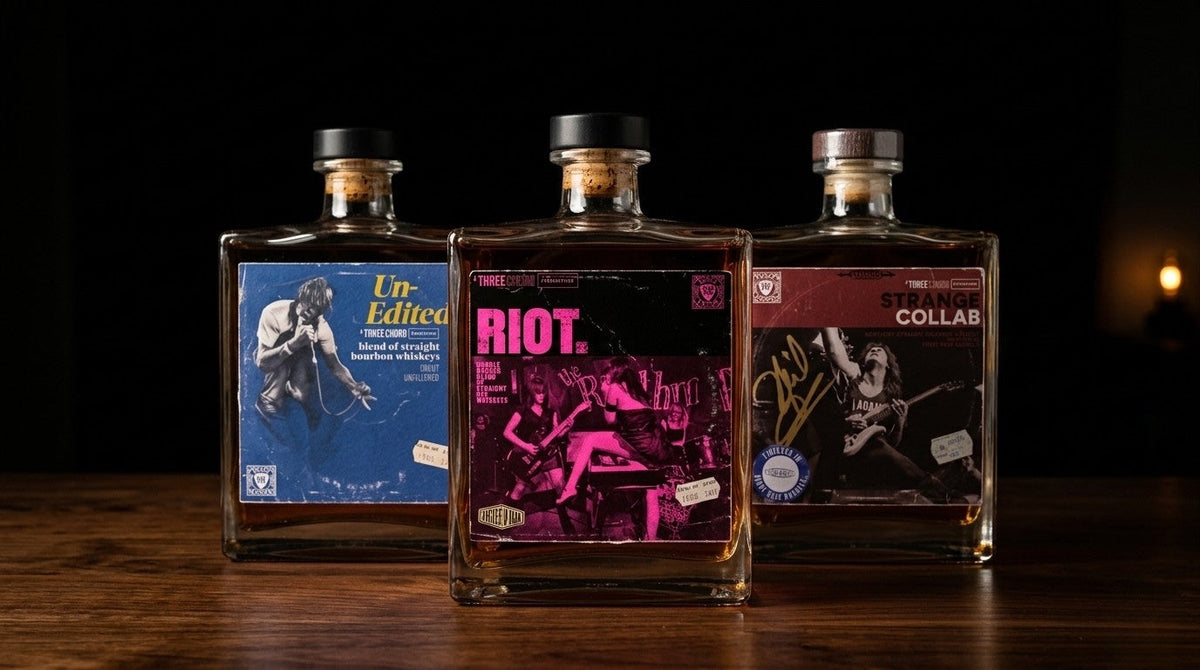
The case for expert blending lives or dies on whether actual bottles back it up. Three Chord, the inaugural Long Pour piece's subject, is exhibit A. Three current expressions, three different blending arguments — none of them possible without genuine, named source relationships.
Two named Kentucky bourbons (Wilderness Trail, Bardstown Bourbon Company), finished at least three months in pinot noir barrels from a named Oregon vineyard (Strange Family). Combined mash bill of 75% corn, 21% rye, 4% malted barley. A fundraising relationship with the Strange family attached to every bottle.
A flipper could not have constructed this product. Expert blending could.
A bonded rye blended from two bonded sources — Bardstown Bourbon Company and MGP Ingredients — via a regulatory arrangement that extends each source's Distilled Spirits Plant (DSP) to Three Chord's bonding warehouse so the three sites count as one bonded facility on paper. By federal law, Bottled-in-Bond is a transparency designation. You cannot ship a bottle that wears the BIB stamp on hidden production. The bottle would be impossible without genuine, contractually formal source relationships.
Three states, three ages — a 4-year Tennessee, a 6-year Indiana, a 7-year Kentucky — blended to a combined mash bill of 76% corn, 18% rye, 6% malted barley, bottled at 118 proof, uncut and unfiltered. Gold medal winner at the San Francisco World Spirits Competition. Multi-source blending across three states at cask strength is a job description, not a label swap.
The point isn't that these three bottles are perfect. It's that each of them is craft work, by every meaningful definition of the word. They just don't fit the marketing template the shame meme was built to attack.
The shame meme had a useful job once. There was a moment in the early 2010s when too many brands were lying about where their whiskey came from, and calling that out mattered. The meme did the work the trade press wouldn't.
That moment is over.
The brands worth your money in 2026 aren't the ones hiding their distillery sources. They're the ones who'll tell you the distillery, the mash bill, the age, and the name of the human who tasted through forty samples to pick the one that ships. That's craft. That's the work. Sourced doesn't mean what the meme thinks it means anymore.
If you're going to be skeptical of a bottle in 2026, be skeptical of the brand whose About page won't tell you where the whiskey was distilled. Be skeptical of the "small batch" label that never names the batch's components. Be skeptical of "proprietary distillation" that never lets you tour the still. The opacity is the tell now — not the sourcing.
Drink the bottle that earns it, not the bottle with the longest origin myth.
Three Chord is in this month's PourMore boxes — Strange in Bourbon Intro, Riot in Whiskey Intro, Unedited in Bourbon Explorer. Every bottle in our Three Chord lineup is expertly blended, sourced from named distilleries, signed by a real master blender, and proud of every single one of those words.
This is the second piece in The Long Pour — PourMore's monthly editorial. Decoded, one bottle at a time. The inaugural piece on Three Chord is here.
No. "Sourced" simply means the brand selling the bottle didn't distill the whiskey themselves — they bought it from another distillery, then blended, finished, proofed, and bottled it. Most premium American whiskey on the shelf today is sourced in some form. The signal that matters is transparency: brands that name their sources and stand behind a real master blender are doing expert work. Brands that hide the source are the ones to question.
An NDP is a whiskey brand that doesn't operate its own distillery — they source distillate from one or more contract distilleries, then handle blending, finishing, proofing, and bottling under their own name. Plenty of NDPs are expert blenders running long-term, transparent source relationships. The category isn't the problem; opacity within the category is.
Yes. MGP Ingredients in Lawrenceburg, Indiana operates a federally registered distillery that produces bourbon, rye, and other American whiskeys to standard mash bills. MGP-distilled bourbon is real bourbon by every legal definition. What gave MGP a "shame" association in the 2010s was that some brands sold MGP-distilled whiskey with fictional log-cabin origin stories instead of naming the actual source. The fault is the fiction, not the distillate.
Four signals. (1) The brand names its source distilleries publicly. (2) A real, named human master blender signs the work. (3) The product has a specific, defensible point of view — a finishing strategy, a blend rationale, a defined character. (4) The brand sells more than one expression with consistent quality across the lineup. Expert blenders hit all four. Flippers usually fail three.
Sources: Kars Petersen interview, PourMore "Inside the Pour" series (May 2026); Three Chord brand materials; U.S. Bottled-in-Bond Act of 1897; 27 CFR § 5.88 (Bottled in Bond labeling rule), TTB; MGP Ingredients, Wilderness Trail Distillery, Bardstown Bourbon Company brand materials; Bourbon Veach — "Rectifiers In The 19th Century" (Mike Veach, retired curator, Filson Historical Society Bourbon Collection); NBC News — "Behind the misleading claims fueling America's bourbon boom".
Copyright Pourmore, Inc. 2026
*If you have a shipping issue or delay please do not hesitate to reach out and we will do our best to address the issue.
States we cannot ship to:
AK, AR, HI, MI, MS, MT, UT
This is a subscription service, all orders (except prepaid gifts) by default renew. Just e-mail us at any questions Contact@Pourmore.com
Orders do not arrive in the wooden box seen in some graphic displays.
PourMore relies upon a network of third party retailers, vendors, distributors, and couriers. When an order is placed it is placed with a licensed third party who fulfills the order. At no time does PourMore take title to, possession of, or inventory related to any order placed on pourmore.com. We are not a retailer.
Copyright Pourmore, Inc. 2026
*If you have a shipping issue or delay please do not hesitate to reach out and we will do our best to address the issue.