Your Cart is Empty

OCTOBER BOXES SOLD OUT - ORDER NOW FOR NOVEMBER CLUB DELIVERY
OCTOBER BOXES SOLD OUT - ORDER NOW FOR NOVEMBER CLUB DELIVERY
The Long Pour — PourMore's monthly editorial. Decoded, one bottle at a time.
By the PourMore editorial team. We hand-select every bottle that goes into our members' boxes, and we've co-launched a Backstage Series bottle ourselves — the Drake White release in 2025, Drake himself in the room. Here's what's actually going on behind that label.
The short version: The celebrity whiskey shelf is crowded with names on labels and not much else. Three Chord's Backstage Series is one of the rare exceptions — bands actually in the blending room, working through barrel samples for as long as it takes, putting their name on a bottle they helped shape. The roster crosses country, rock, hardcore, and pop-rock. The only consistent filter is whether the musicians will actually show up. Here's what real celebrity-whiskey collaboration looks like — plus a four-point test you can carry to any other celebrity bottle on the shelf.
In this piece
The celebrity whiskey shelf has gotten crowded. Country stars. Football players. Actors. Comedians. Three or four bottles every quarter, each with a press release that says the same thing: "hands-on involvement in developing the flavor profile."
Most of the time, "hands-on involvement" means a Zoom call, a finished sample to approve, and a royalty agreement. Sometimes it means more. Three Chord runs a line called the Backstage Series where it's almost always the second thing — bands in the room, tasting through barrel samples, blending toward a profile they actually want their name on. We've shipped Backstage bottles to PourMore members. Here's what's actually happening on the inside.
This piece is for anyone who's bought a celebrity-named bourbon hoping it would be more than a marketing exercise — and wondered how to tell the difference next time.
In 2025, PourMore co-launched the Drake White Backstage Series bottle with Three Chord. Drake himself was in the room. We tasted the bottle alongside him, asked the questions that don't make it into press releases, and walked away with enough context to recognize a real collaboration when we see one. We also recorded a full conversation with Drake for the launch — check out the Only Bourbon Fans podcast episode featuring Drake White if you want to hear what he had to say about the process, in his own words.
That's the credibility anchor for everything in this piece — we've been on the inside of how Three Chord does these collaborations, not just reading the marketing.
Three Chord's Backstage Series works because the brand was built with music-business depth on the team from the start. The people who pick up the phone to bands aren't the marketing department — they're folks who already had music-industry careers before they came to whiskey, and the relationships came with them. That structural fact is the difference between a brand that can land a Backstage candidate on a 48-hour call and a brand that has to route a request through three layers of management to maybe get a one-line "no" three months later.
It's also the reason the Backstage roster reads like a working musicians' Rolodex rather than a press-release filler. The brand can credibly invite a band into the blending room because somebody on the Three Chord side has known the band, or known someone who knows the band, for a long time. That's a structural advantage that competitors with budgets but no music-business roots can't shortcut.
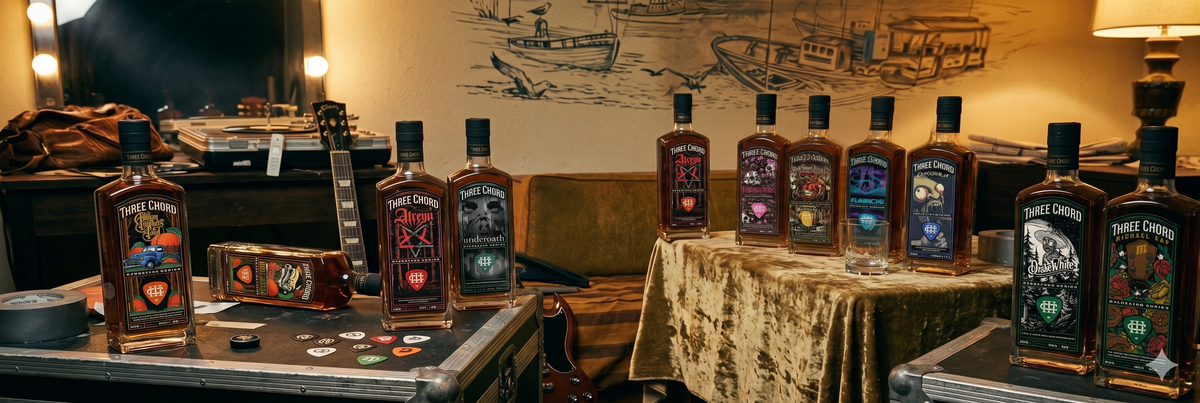
Three Chord has produced Backstage Series collaborations with:
The roster crosses country, Southern rock, metalcore, hard rock, and pop-rock. The connector isn't genre — it's bands willing to actually show up. A model that can credibly produce both an Allman Brothers tribute bottle and an Underoath collab isn't optimizing for genre fit. It's optimizing for the band's commitment to the process.
Most band members who agree to a collaboration go in expecting it'll be a few decisions and a check. The ones who finish it come out genuinely surprised by how much input the process actually demands of them. Three Chord doesn't ship a finished bottle for the band to bless. They build the bottle with the band, and that takes time the band has to actually give.
For more on how Three Chord operates as a brand outside the Backstage Series — sourcing, blending, the recent rebrand — see our brand introduction: Three Chord, decoded — the brand that refuses to fit a box.
The collaboration always starts with a real conversation. From Three Chord's master blender on how it opens:
"We'll sit on a meeting with them, talk about like what they actually like to drink, what they want their product to taste like. Whether it's going to be similar to what they like to drink or if they want something totally their own." — Kars Petersen
This is already further than most celebrity-whiskey deals get. Asking a band what they actually drink — and what they'd actually want — is a real briefing, not a stylistic checkbox. The answer shapes everything that follows.
This is where most celebrity-whiskey collaborations either end or never started. Three Chord's process keeps going. The brand's stated approach is that they'll work with a band "for as long as it takes," iterating through samples until the band is genuinely happy to put their name on the bottle and the brand is happy to put it out. Some bands take a long time. The process accommodates that.
For as long as it takes is the operative phrase. Three Chord isn't optimizing for fast turnaround. They're optimizing for a bottle the band would actually want their name on five years from now.
A practical filter readers can use on any celebrity-named bourbon they encounter. A real collaboration meets at least three of these. A name-license deal usually meets zero.
Three out of four or skip it. The test is portable — it works on every other celebrity bourbon you'll see on the shelf next year.
Four collaborations, four very different musical sensibilities translated into a glass. PourMore has been a partner channel for several of these bottles — meaning when we say "we shipped this one to members," that's the editorial relationship behind the recommendation.
The Drake White Backstage bottle — the one we co-launched, covered up in The Story — translated Drake's musical sensibility cleanly. Country with enough Southern rock running through it to keep things from getting predictable, and the production direction shows it. A bourbon profile leaning warmer and rounder than the cask-strength end of the catalog, sized for the kind of conversation that goes longer than one round. The bottle is also a useful proof point on the broader Backstage model: a band that actually shows up doesn't end up with a generic celebrity-bourbon profile. They end up with a bottle that sounds like them.
Producing a Backstage Series bottle with an institution-level band is a different kind of project. The conversations are with the rights holders and the surviving creative voices. The brief is to honor a legacy without turning the bottle into a museum piece.
The bottle itself is a blend of Indiana and Tennessee bourbon finished in toasted peach wood — a direct callback to the band's 1972 album Eat a Peach. Production decisions tied to specific album titles is the kind of thing that signals the collaboration was real: somebody had to argue for the peach wood. Somebody had to taste through samples to land on the ratio that read as a tribute rather than a gimmick.
The result lands in PourMore boxes and shows up on shelves where Southern-rock-bourbon overlap is real — meaning, basically everywhere good bourbon is poured by people who also remember why the Fillmore East mattered.
A metalcore band making whiskey is the kind of cultural crossover that earns a story on its own. Underoath agreed because the brief wasn't "make a generic celebrity bourbon with our name on it." It was "make something that fits the band the way the band actually sounds." That meant a profile the genre's expected gentle-bourbon defaults didn't predict. The bottle that landed in PourMore boxes was sharper, less polite, and considerably more interesting than the label might lead you to expect.
Pop-rock founder Andrew McMahon's project is the announced next Backstage release. Production specifics aren't public yet. What we'd bet on, given the model: a profile that genuinely reflects what Andrew actually drinks and what he wants on a piano bench between sets. We'll know when the bottle ships. When it shows up in PourMore boxes, we'll tell you the rest of the story.
Most celebrity whiskey isn't fake. It's just transactional. A name. A check. A press release. Nobody loses sleep over it because nobody promised otherwise.
The Backstage Series is something else. A model that requires bands to spend real hours in the blending room. A master blender willing to throw out 12 samples to find the one that works. A roster that crosses genre because the only consistent filter is will the musicians actually show up?
These bottles are not on the shelf at your local Total Wine. They ship in finite collaboration batches, move through partner channels, and disappear. Trying harder won't find them — only an inside line will. That's not a complaint about retail. It's the structural reality of allocation-tier collaboration releases.
The next time a celebrity bourbon hits the shelf with a famous name on it, you have a usable test now. Names, components, story, finite release. Three out of four or skip it.
Three Chord's current core lineup — Strange in Bourbon Intro, Riot in Whiskey Intro, Unedited in Bourbon Explorer — is in this month's PourMore boxes. These are the everyday Three Chord expressions, the bottles that show the brand's process at scale. The Backstage Series bottles rotate with each release; when one shows up in a member box, we'll tell you the story behind it the same way we just told you the story of this one.
This is the third and final piece in our May Three Chord coverage. The cluster: Three Chord, decoded (the brand introduction) + The case against sourcing shame (the POV companion) + this piece (the Backstage Series category context). All three live in The Long Pour — decoded, one bottle at a time.
It depends on the collaboration. A lot of celebrity-named bourbon is what the industry calls a "name-license" deal — the brand handles all production, the celebrity signs off on a sample, and the contract pays royalties. Real collaborations like Three Chord's Backstage Series are the exception, not the rule — the artist is in the blending sessions, tasting through samples, and helping shape the final profile.
The Backstage Series is Three Chord's line of musician-collaborated whiskies. Each bottle is co-developed with a band or artist who actually participates in the blending process — selecting components, tasting through samples, and directing the sensory profile. Releases to date include collaborations with Drake White, the Allman Brothers Band, Underoath, Halestorm, Theory of a Deadman, and an upcoming Jack's Mannequin bottle. Each release is finite — when it's gone, it's gone.
Use the four-point test. (1) Specific band members are named as participants — not just "the band." (2) The sensory direction is described in production language — mash bill, finishing strategy, proof — not vague marketing terms. (3) The blend's components are disclosed — source distilleries, age, mash bill. (4) The release has a finite story — a tour, an album, a milestone — not a perpetual line. Real collaborations meet three or four. Name-license deals meet zero.
The Three Chord Backstage Series roster includes Drake White (country), the Allman Brothers Band (Southern rock), Underoath (metalcore / post-hardcore), Halestorm (hard rock), Theory of a Deadman (rock), and an announced upcoming release with Jack's Mannequin (Andrew McMahon's pop-rock project). The lineup crosses genres deliberately — the only filter Three Chord applies is whether the band will commit the time the blending process actually requires.
Sources: Kars Petersen interview, PourMore "Inside the Pour" series (May 2026); Three Chord brand materials (Backstage Series); PourMore's own partner-channel history with the Drake White, Allman Brothers Band, and Underoath Backstage Series releases; Drake White × Three Chord × PourMore — Only Bourbon Fans podcast (2025); Whisky Advocate — Three Chord Backstage Series Allman Brothers (2025).
Copyright Pourmore, Inc. 2026
*If you have a shipping issue or delay please do not hesitate to reach out and we will do our best to address the issue.
States we cannot ship to:
AK, AR, HI, MI, MS, MT, UT
This is a subscription service, all orders (except prepaid gifts) by default renew. Just e-mail us at any questions Contact@Pourmore.com
Orders do not arrive in the wooden box seen in some graphic displays.
PourMore relies upon a network of third party retailers, vendors, distributors, and couriers. When an order is placed it is placed with a licensed third party who fulfills the order. At no time does PourMore take title to, possession of, or inventory related to any order placed on pourmore.com. We are not a retailer.
Copyright Pourmore, Inc. 2026
*If you have a shipping issue or delay please do not hesitate to reach out and we will do our best to address the issue.