Your Cart is Empty

The Long Pour — PourMore's monthly editorial. Decoded, one bottle at a time.
By the PourMore editorial team. We hand-select every bottle that goes into our members' boxes. This is Part 1 of two — the story you can tell from the outside. Part 2 is our conversation with the distillery.
The short version: Almost every bourbon you've had was a collaboration between places — grain from one state, distillate from another, a name dreamed up in a third. Wyoming Whiskey is one of the few that happens in a single spot: Wyoming-grown grain, water from a mile-deep aquifer, distilled and aged in the Bighorn Basin through a climate that swings from well below zero in winter to 135°F in summer. That's not a marketing line — it's a structural choice almost nobody makes. So it's a clean test of a question whiskey people argue about constantly: does where a whiskey is made actually change what's in the glass? Here's the story, the terroir argument, and a walk through your two bottles — the Small Batch flagship and the just-released National Parks No. 5, a five-year tribute to Grand Teton that sends $50,000 to help protect the park.
In this piece
Wyoming Whiskey is the first legal distillery in the state of Wyoming. It sits in Kirby, a town in the Bighorn Basin with a population you could fit on a school bus. That's the first thing worth knowing, because it explains the second thing: this was never going to be a convenient way to make whiskey.
The distillery was founded in 2009 by Kate and Brad Mead — a Wyoming ranching-and-law family — alongside their friend David DeFazio. The idea was almost stubbornly simple: make Wyoming's first real whiskey, out of what Wyoming actually grows and pumps out of the ground. No sourced barrels trucked in from Indiana. No commodity corn. The whiskey would be of the place or it wouldn't be worth doing.
To make that idea drinkable, they brought in Steve Nally — a 33-year veteran of Maker's Mark and a Bourbon Hall of Fame distiller — to write the recipe and build the processes from scratch. That detail matters more than a résumé line usually does. Nally spent three decades on one of the most famous wheated bourbons in the world, and the recipe he built for Wyoming is wheated too. Hold onto that; it's the key to what you taste.
"Terroir" is a wine word. It's the idea that a place — its soil, water, and climate — leaves a fingerprint on what's grown and made there. Wine drinkers take it as gospel. Whiskey drinkers fight about it, because most whiskey is built to erase place, not express it: commodity grain from wherever's cheapest, distillate bought from a giant Indiana plant, then blended to a consistent house style.
Wyoming Whiskey is interesting precisely because it does the opposite. Three things in the bottle come from one stretch of high desert:
Is terroir "real," then? You don't have to settle the whole debate to notice the obvious: if place ever shows up in a glass, it should show up here, where one company controls the grain, the water, and a genuinely extreme barrel climate. Wyoming Whiskey is the cleanest version of the experiment on the American shelf. That's the whole reason it's worth pouring with a little attention.
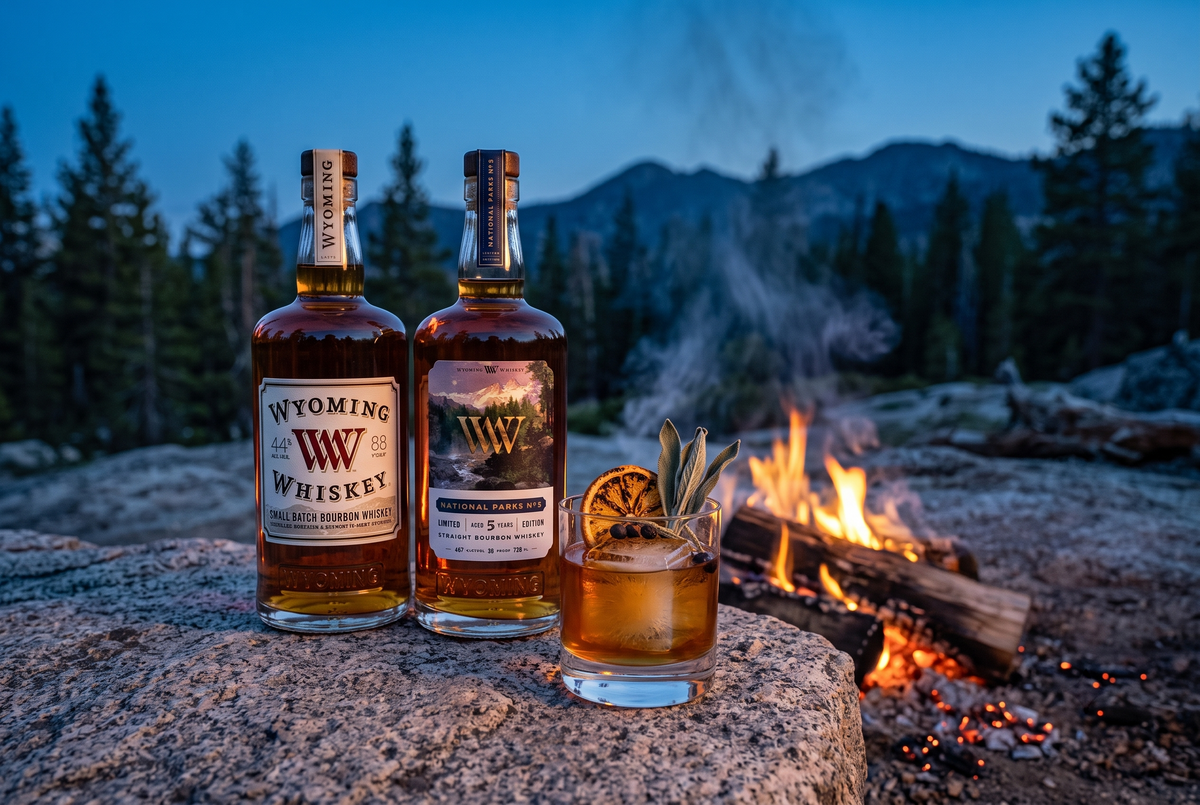
We sent two Wyoming Whiskey bottles this month, and they're a deliberate pair: the everyday flagship and a just-released collector's bottle.

Wyoming Whiskey Small Batch — your Bourbon Intro bottle. This is the flagship, the Steve Nally wheated recipe (68% corn, 20% wheat, 12% malted barley). Because wheat sits in the secondary-grain slot instead of rye, it drinks round and soft — caramel, vanilla, baked orchard fruit, and a little butterscotch — without the pepper-forward bite a high-rye bourbon throws. It's the brand's most direct expression of that grain-and-climate fingerprint, and the bottle the distillery built its name on — it took Double Gold at the 2023 San Francisco World Spirits Competition, one of the most competitive blind-judged contests in the spirits world. Wyoming Whiskey Small Batch →

Wyoming Whiskey National Parks No. 5: A Tribute to the Tetons — your Bourbon Explorer bottle. This is the one to slow down for. It's the fifth release in Wyoming Whiskey's annual National Parks series — limited, brand-new (it hit shelves in late 2025), and we grabbed it for our people the moment it dropped. We've got a small number left while supplies last — grab one here. A few things make it special:
The rest of the Wyoming shelf, worth knowing. If these two land for you, here's where the rabbit hole goes:
A National Parks bottle deserves a pour that tastes like where it came from. So we built one for it — earthy, a little piney, the liquid version of a cold morning above the tree line. (Timberline is the elevation where the forest gives up and the bare peaks begin. Fitting for a Teton tribute.)
It's an Old Fashioned with a high-country accent. Use the Small Batch for an easy-drinking version, or pour the National Parks No. 5 if you want its espresso-and-leather finish to carry the drink.
The Timberline
Garnish: express an orange peel over the top and drop it in, then add a rosemary or pine sprig. For the full campfire, clap the sprig between your palms — or pass it over a flame for a second so it smokes — before it goes in the glass.
Why it works: the maple and black walnut lean into the bourbon's caramel-and-leather side, while the pine (or rosemary) and orange cut the sweetness so it finishes crisp instead of heavy. It tastes a little like the place the bottle is named after — which is the whole point.
Here's the honest case. You can find perfectly good bourbon at your local store, and we'd never pretend otherwise. But "good bourbon at the store" and "a bottle that's a clean argument about whether terroir is real" are two different experiences — and the second one is the reason a discovery club exists.
Wyoming Whiskey isn't on most shelves outside its home region, and when it is, it's easy to walk past without knowing why it's different. The why is the whole point: this is one of the few American whiskeys made entirely in one extreme place, by a recipe from a Hall-of-Fame wheated-bourbon distiller, aged through a climate that does things to oak that Kentucky never could. That's not a bottle you stumble into. It's a bottle someone hands you and says, okay, taste this and tell me place doesn't matter.
That's why it's in the box.
Part 2 is here. Everything above is the story you can tell from the outside. The part only the distillery can tell — the recipe decisions, the barrel program, what those brutal temperature swings actually do over five years — is now live: Inside the Wyoming Whiskey distillery, a conversation with co-founder David DeFazio.
Is Wyoming Whiskey a "real" bourbon if it's not from Kentucky?
Yes. Bourbon has no geographic requirement beyond being made in the United States — it has to be at least 51% corn, aged in new charred oak, and meet a few proof rules. Kentucky makes most of it, but "bourbon" is a recipe-and-process definition, not a zip code.
What does "wheated" mean?
The secondary grain in the mash bill is wheat instead of rye. Wheat generally drinks softer and sweeter, with less of the peppery spice rye brings. It's the same family as some of the most sought-after bourbons in the country.
Why does the extreme Wyoming climate matter for aging?
Whiskey ages by moving in and out of the charred oak as the barrel expands in heat and contracts in cold. Wyoming's huge annual temperature swings drive more of that exchange, so the whiskey can pull more color, flavor, and texture from the wood than a milder climate delivers in the same number of years.
What is the National Parks series?
It's Wyoming Whiskey's annual limited-edition bourbon, made in partnership with the Grand Teton National Park Foundation, with a set donation from every bottle going to protect the park. No. 5 — "A Tribute to the Tetons," with Thomas Moran's 1895 painting on the label — is the newest. Each release is its own bottling, which is why people collect them.
Sources: Wyoming Whiskey (Made of Wyoming — Our Process; National Parks No. 5); Grand Teton National Park Foundation; Fred Minnick; Breaking Bourbon (National Parks No. 5 review + the No. 5/Moran press release); The Spirits Educator; Breakthru Beyond; Pour Atlas; American Whiskey Magazine. Small Batch: Double Gold, 2023 San Francisco World Spirits Competition.
Want bottles your local shelf can't get, picked by people who do this for a living? That's the whole idea of the club — and if you want to start with this one, the Wyoming Whiskey Small Batch is right here. We've also got a few National Parks No. 5 and a very limited amount of the Double Cask left — while supplies last.