Your Cart is Empty


Leopold Bros
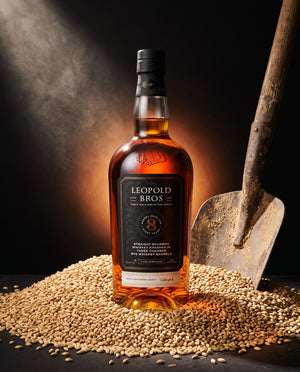
Most big bourbons use a little malted barley and let added enzymes do the rest, because malt is expensive. Leopold Bros goes the other way: 65% corn, 15% rye and 20% barley they malt themselves on a floor in Denver. Malting means sprouting the grain and drying it so its starch turns into sugar. Todd Leopold keeps the malt high so you can taste the grain. "If you can't taste even a hint of corn, that's not bourbon," he told us.
It's pot distilled, goes into new charred oak at 100 proof, and sits eight years in a dunnage warehouse: low racks on an earthen floor, built to keep Denver's dry air from stealing the whiskey. Then it spends a few months in barrels that held Leopold's Three Chamber Rye. Todd says he did that partly "because I thought it was funny. Who the hell finishes a bourbon in a rye cask?" The real reason was the lavender note and oily texture those barrels carry.
Leopold siphons each barrel out instead of tipping it over, so the char stays behind and the whiskey goes into the bottle unfiltered. Todd says the proof barely moved for five years, then crept up to about 55% by year eight, barrel after barrel.
It landed at #63 on Fred Minnick's Top 100 American Whiskeys of 2024.
Poured by Bourbon-of-the-Month Club members in August 2024.
What does "Three Chamber Finished" mean?
After eight years in new oak, the bourbon spends a few months in barrels that previously aged Leopold's Three Chamber Rye. That rye comes off a rare kind of still Leopold rebuilt from old plans, and its barrels carry floral, oily character into the bourbon.
What's floor malt?
Barley spread across a floor, soaked, left to sprout and turned by hand with shovels, then dried in a kiln. Leopold runs its own malt house in Denver, so the malting happens on site.
Why is the proof written by hand?
It's cask strength, so each batch comes out a little different. Leopold writes the number on each label.

