Your Cart is Empty

OCTOBER BOXES SOLD OUT - ORDER NOW FOR NOVEMBER CLUB DELIVERY
OCTOBER BOXES SOLD OUT - ORDER NOW FOR NOVEMBER CLUB DELIVERY

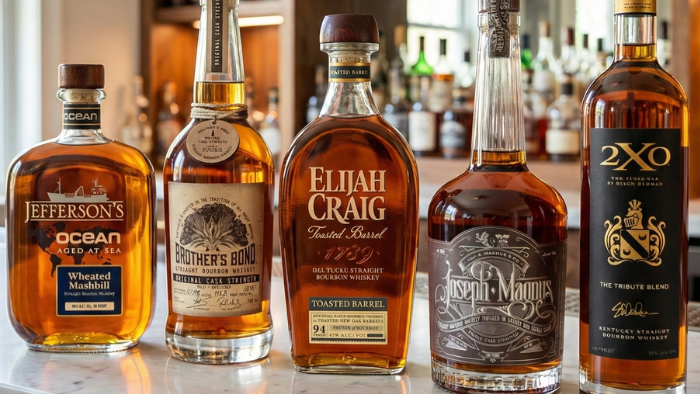
Most bourbon pairing guides recommend steak, chocolate, and cigars. That's not a pairing guide. That's three stock photos. The actual relationship between bourbon and food is more specific, and more interesting, than the usual list suggests. The right pour with the right dish creates a third flavor that neither one produces on its own. The wrong one makes both taste worse.
Here are five bourbon-and-food pairings that actually work, with the reasoning behind each one — so you can apply the logic to whatever's on your own table.
The cliché pairing is bourbon and steak. The reason it's a cliché is that it works — but not every bourbon with every steak. The specific combination that earns its reputation: a high-rye bourbon (meaning rye makes up more than the usual 10% of the grain bill) with a well-marbled ribeye cooked medium-rare.
The mechanism: rye brings pepper and spice to the bourbon. A ribeye has enough fat that it coats the mouth, which needs something with structure to cut through. The pepper in a high-rye bourbon does that job. The caramel notes from the barrel echo the Maillard reaction on the crust of the steak. The overall effect is that both the bite and the sip taste bigger than they would alone.
The pour: Wild Turkey 101, Four Roses Single Barrel, or Bulleit. All high-rye. All under $50.
Don't use: a wheated bourbon (too soft for the steak's fat). And skip the 120-proof barrel proof here — it'll overwhelm. We get into why in our whiskey and steak guide, which goes deeper on cuts and proof.
The trick with cheese isn't matching the intensity — it's matching the fat. Cheese is fat-heavy, often salty, sometimes sharp. A wheated bourbon (wheat instead of rye as the secondary grain, which drinks softer and sweeter) brings sweetness and body without aggression. With aged cheddar, the effect is almost cream-like: the cheddar's salt hits, the wheated bourbon's vanilla responds, and the whole pairing reads like a richer version of both.
Aged cheddar specifically — not a young cheddar — because the time in the cave brings out nuttiness and a dry crumbly texture that a bourbon with heat would crash against. A softer bourbon smooths it out.
The pour: Maker's Mark 46, Weller Special Reserve, or Larceny.
Same logic applies to other aged, firm cheeses: manchego, aged gouda, parmigiano-reggiano. Skip the blue cheese for wheated bourbon — the funk is better matched with a high-proof bourbon (see pairing four).
Dark chocolate and bourbon share more than people realize. Both start with a fermentation step. Both get a lot of their complexity from oak (chocolate makers age the nibs, distilleries age the whiskey). Both develop bitter, smoky, and fruity notes depending on how they're processed. Which means the pairing isn't a matter of balancing opposites — it's finding the right mirror.
The mirror for good dark chocolate (70% cacao or higher) is a long-aged bourbon. Something that's spent 10+ years in oak will have developed the same kind of dried-fruit, tobacco, and leather notes that dark chocolate gets from long conching. Put them in the mouth at the same time and they recognize each other.
The pour: Knob Creek 12-Year, Russell's Reserve 13, Michter's 10-Year.
The chocolate: 70–85% cacao, single-origin if you can find it. Skip milk chocolate — too sweet, it cancels the bourbon's oak character.
This is the pairing nobody expects, and it's the one that converts people. Blue cheese is pungent, salty, and fat-heavy, with a funky mold character that most wines can't match. It bullies softer bourbons. What it wants is something equally loud.
A barrel-proof bourbon (meaning the whiskey went into the bottle at whatever proof it came out of the barrel, no water added) gives you that. Usually 115–125 proof. More concentrated flavor, more weight, enough backbone to stand up to the blue. The combination is unhinged in a good way — the cheese's funk meets the bourbon's sweet oak, and a third flavor shows up that's bigger than either one.
The pour: Elijah Craig Barrel Proof, Wild Turkey Rare Breed, Stagg Jr. (if you can find one).
Same logic works with other funky, fat-heavy foods: pâté, rillettes, anything with long aging or fermentation. If you want to understand what high proof actually does to flavor, our high-proof bourbon guide covers the mechanics.
Barbecue — real, low-and-slow smoked meat — is a pairing most people get wrong by reaching for beer. Beer is fine. But bourbon is better. Specifically, a single-barrel bourbon with enough char character to echo the smoke.
Bourbon is legally required to age in new charred oak barrels. That char — the alligator-skin carbonized layer on the inside of the barrel — gives bourbon its smoke, its depth, and a specific vanillin-and-burnt-sugar note. Put that next to a brisket that's been in a smoker for 14 hours, and the char on the barrel meets the smoke on the meat. They're not competing. They're completing.
Single-barrel is the right format here because each barrel's char is a little different — you're getting the specific smoke character of one specific piece of wood, not a blend. That specificity is the pairing's payoff.
The pour: Four Roses Single Barrel, Knob Creek Single Barrel Reserve, Russell's Reserve Single Barrel.
The food: brisket, pulled pork, ribs, or a smoked pork shoulder. Anything that spent more than six hours in a smoker.
If you pull back from the five specific pairings, three principles hold across almost every bourbon-and-food match:
Match the fat with enough proof to cut through it. Fatty food coats the mouth. Bourbon with body and proof clears the coating. Steak, pork belly, aged cheese — all want a bourbon with structure.
Mirror the barrel-derived flavors. Smoke, char, caramel, vanilla, and dried fruit all come from the barrel. Foods that have been through their own wood treatment (smoked meats, barrel-aged cheeses, chocolates conched with oak) find a natural partner in bourbon.
Let the spice in the grain bill do work. A high-rye bourbon brings pepper. A wheated bourbon brings softness. Neither is better — they're different tools. Match the tool to what's on the plate.
Start with two questions. How fatty is the food? How intense are its flavors? Then match the bourbon along the same lines. Low-fat, mild food → approachable bourbon (Buffalo Trace, Maker's Mark). High-fat, mild food → wheated (Weller, Larceny). High-fat, intense food → barrel proof (Elijah Craig BP, Stagg). Smoked food → single barrel. Spiced food → high-rye.
It's not complicated. It just requires thinking about what's on the plate instead of grabbing whatever bottle is closest. For a broader view of specific bourbons worth having on hand, the best bourbon brands guide walks through the shelf at every price. And if comfort food is the direction you're going, the whiskey food pairings piece covers a wider category.
Bourbon pairs better with food than most people realize — not because bourbon is a wine substitute, but because the category's range (from 80-proof wheated to 130-proof barrel strength) gives you real tools to match real plates. The five pairings above are starting points. The logic behind them is the thing worth keeping.
If you'd rather have interesting bottles show up each month so pairing experiments become a weekly thing, here's how the club works.
Copyright Pourmore, Inc. 2026
*If you have a shipping issue or delay please do not hesitate to reach out and we will do our best to address the issue.
States we cannot ship to:
AK, AR, HI, MI, MS, MT, UT
This is a subscription service, all orders (except prepaid gifts) by default renew. Just e-mail us at any questions Contact@Pourmore.com
Orders do not arrive in the wooden box seen in some graphic displays.
PourMore relies upon a network of third party retailers, vendors, distributors, and couriers. When an order is placed it is placed with a licensed third party who fulfills the order. At no time does PourMore take title to, possession of, or inventory related to any order placed on pourmore.com. We are not a retailer.
Copyright Pourmore, Inc. 2026
*If you have a shipping issue or delay please do not hesitate to reach out and we will do our best to address the issue.