Your Cart is Empty

The Long Pour — PourMore's monthly editorial. Decoded, one bottle at a time.
We sat down with Highland Park's senior global brand ambassador, opened two bottles of the 18 eleven years apart, and spent an hour on the history of a distillery that shouldn't exist.

Martin Markvardsen picked up from Denmark with a suitcase half-packed for a three-week American tour — Los Angeles, San Francisco, New York, then Texas, in that order, which is the long way around and he knows it. We asked how he was doing.
"I'm here talking about my favourite subject," he said, "so it can't be bad."
He has been talking about it for a while. Markvardsen is Highland Park's senior global brand ambassador, 38 years in whisky, 20 of them with this distillery, and by his own account the longest-serving ambassador of any Scotch brand in the world. He still flies up to Orkney every second month to work with the team. We got him for an hour, opened two bottles of the Highland Park 18, and spent most of it on the history of a distillery that, by any sensible reading of a map, should never have been built.
Start with the barley. It doesn't grow on Orkney. The wind won't let it.
Everything — the malted barley, the casks, the yeast — arrives by ferry, and the ferry is at the mercy of the same weather. "Quite a lot of ferries will be cancelled or delayed," Markvardsen said, "which always means that sometimes we have to shut down for production for a day or two. Which is not what everyone else has to do."
He's fond of the absurdity of it. "We make whisky where no one else could," he told us. "No one else would. But we still do it."
In this piece
The bottle says 1798. What happened in 1798 was an arrest.
Magnus Eunson — Mancy, to Orkney — had three jobs and a side business. He farmed. He kept a butcher's shop in Kirkwall. And he worked for the church as a beadle, which Markvardsen stopped to correct mid-answer, because the books keep promoting the man: a beadle helps out around the church. He was not a priest, and he was not a minister.
The side business was distilling, at night, illegally. And the church job is the good part, because of where he stashed the results.
"He put it into small jars, or casks, and he took it back to the church," Markvardsen said, "where he hid it under the pulpit of the church, holes in the walls, and even in old coffins."
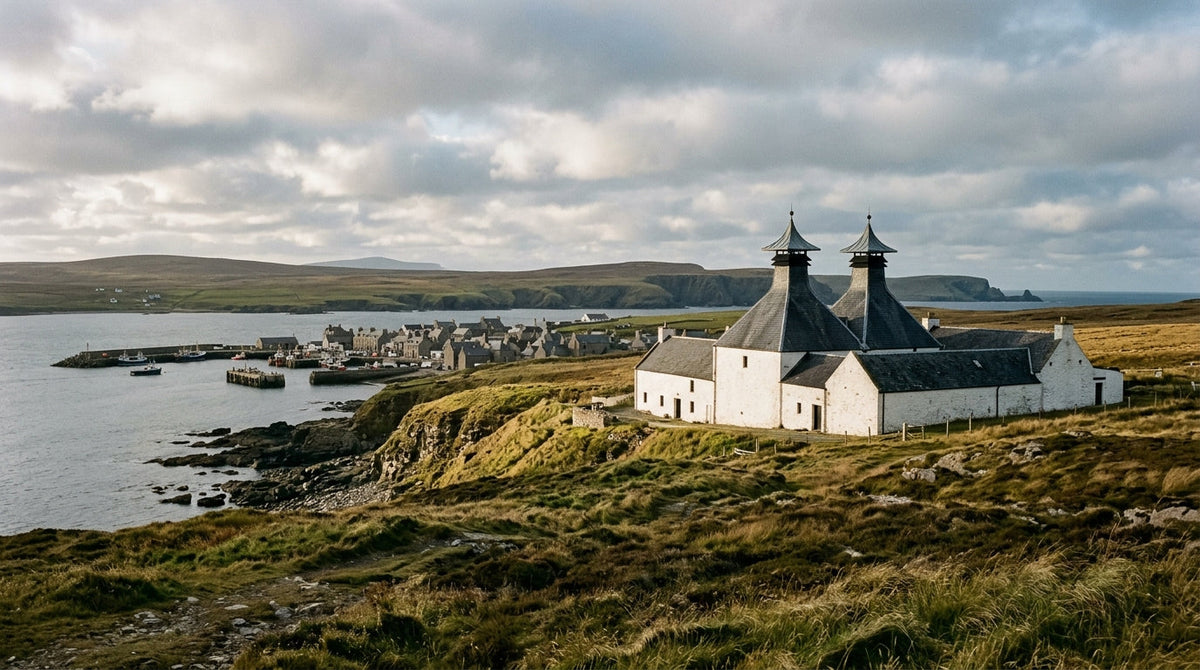
Eunson also picked his ground like a man expecting company. The distillery sits on High Park, the high ground above Kirkwall, and it sits there because from the top of that hill he could watch the harbour — which bought him enough time to hide the stills before the excisemen finished the climb.
The system held until 1798, when it didn't. He paid a licence for a few years afterward, then quietly stopped, working on the reasonable theory that Orkney was far enough from anywhere that nobody would bother coming. In 1813, somebody came. An excise officer named John Robertson caught him a second time and sentenced him to leave the island for good. Eunson walked away from his bothy and his still.
Robertson then took over the distillery — bought into it, in most published accounts, as part of a syndicate that included a fellow exciseman. Markvardsen's version is blunter: the man whose job was catching illegal distillers spent years running the still he'd confiscated, and the site didn't hold a licence until 1826. When we pointed out that this left nobody to arrest him but himself, Markvardsen didn't disagree.
The tidier history is a little less fun. The first licence at High Park is generally credited to Robert Borwick rather than to Robertson, and the 1823 Excise Act gave the islands a grace period, which is the likelier reason the paperwork lands in 1826 than any long-running act of defiance. Worth saying too that Eunson's role is contested — some accounts hand the founding to a farmer named David Robertson instead. The distillery's own telling puts Eunson at the centre, and it's the version Markvardsen tells, but the records from 1798 on Orkney are thin enough that anyone claiming certainty is overselling.
His own summary of the founding is the best line in the interview, and he delivers it like a man who has enjoyed saying it before:
"We got caught, but we can't really write that on the bottles, can we? So we kind of use the word established."
For a sense of the scale Eunson was operating at: the old papers suggest around 400 to 500 litres a year. The standard defence of the era was that a still was for personal consumption, and the excise men mostly went along with it. Four hundred litres is a lot of personal.
This is roughly where the conversation went sideways in the best way, because one of us wrote a college paper on Scotch and the history of tax and tariff policy, which is not a sentence that usually earns you anything at a party. Markvardsen was delighted. Whisky tax predates the 1823 act that finally organised the whole business; it was just collected unevenly, argued about constantly, and dodged with real creativity by men like Eunson.
Highland Park has been the northernmost Scotch distillery in Scotland since 1798, and it's about to lose the title to a new distillery opening in Shetland. Markvardsen's reaction to handing over a 228-year run was a shrug and an "it's okay."
The detail that lands better than the title: Orkney sits at roughly the same latitude as the south coast of Greenland. Dark winters, bright summers, and wind more or less constantly, because the island sits at the point where the Atlantic and the North Sea run into each other.
If you're thinking of visiting, he has a warning wrapped in a joke. Roughly every third flight into Orkney gets cancelled by weather. "So you might never go," he said. "And one thing you have to have in mind — if you go, you might never leave."

Peat is decomposed plant matter, compressed over thousands of years, cut and dried and burned to dry malted barley. Smoke gets into the grain, grain becomes whisky, whisky tastes smoky. Most explanations stop there, which is a shame, because the interesting part is one step further along.
Peat isn't a single substance. It's whatever happened to be growing where it formed.
"Going back in time, trees never survived in Orkney," Markvardsen said. "But heather did."
So the peat Highland Park cuts from Hobbister Moor — 3,000 to 4,000 years old at the surface, which matches the published work on Orkney's bogs — is built from heather and sphagnum moss. The small purple flowers that grow low to the ground and refuse to die in a gale, packed down with the moss around them. What it isn't is wood. Orkney lost its woodland thousands of years ago and never got it back, so there's no tree matter in the ground to burn. And that difference produces the most useful thing he said all afternoon:
"Even though we will use the same amount of peat as they will do at some of the very heavily peated whiskies, we might get the same PPM figure — but flavours will be completely different. This is probably the closest we come to when we talk terroir of whiskies."
PPM means parts per million, and it's the number the industry reaches for when it wants to tell you how peated something is. What Markvardsen is pointing out is that the number measures how much phenol is in there and says nothing at all about what kind — so two whiskies can post an identical figure and taste like they came from different countries, because the plants that made the peat were different plants.
Take that to a shelf and you are immediately better at reading a label than you were an hour ago. It also explains why the smoke here sits underneath the whisky instead of on top of it, which is entirely on purpose: "There's lots of other whiskies on the market that have much more peat and smoke, and this is not what we want. We want the peat smoke to be very, very delicate."
He then volunteered something a brand doesn't strictly have to tell you. That delicate smoke has only been consistent for about 50 years. Before that, back when Highland Park mostly sold to blenders, it wandered around depending on the weather, because a good wind pulled the smoke through the pagoda roofs faster than a still day did. Same peat, different Tuesday, different whisky.
For years Highland Park sold hard on Norse heritage — black label, Viking pattern, a run of releases named Thor, Odin, Loki and Freyr. Orkney has the receipts for it. The islands were under Danish and Norwegian rule until 1468, when they were handed to Scotland as a pledge against a royal marriage, on a handshake, with no letter ever written and the money never repaid.
Then the brand turned the whole theme down on purpose, and the reason is worth sitting with.
"The new generation of whisky consumers — not so much," Markvardsen said of the Viking framing. "So when they saw our bottle with the black label and the Viking pattern and the stories, they immediately thought that Highland Park was a heavily peated, very strong, smoky whisky, and didn't really wanna try it. It was already too strong for them."
The packaging was making a promise the whisky had no intention of keeping. So the label went white, flecked with small purple heather marks, and the story moved to the island, which has considerably more going on than longships — Skara Brae, Maeshowe, the Ring of Brodgar, the Picts. Orkney's heritage runs back five or six thousand years, not one.
Markvardsen's reasoning for the switch is blunt, and we think he's right: "Vikings doesn't make us different taste-wise." The peat does.

The core range is the 12, the 15 and the 18, with the 21, 25, 30 and 40 sitting above it and the occasional 54 and 56 sitting somewhere above that. A cask strength arrived about six years ago at roughly 63% ABV, blended from something like 50 casks — "the closest you get to going into a warehouse at Highland Park and taking the valinch and putting it into your glass," and also, he warns, a whisky that will remove your head if you haven't learned how to approach it.
The range is bigger than it once was and smaller than it briefly became. The 12 launched in 1979 and was the only Highland Park on the market for about two decades. The 18 arrived in 1997, a year before the distillery's 200th anniversary. Then came a rush of limited editions — Thor, Odin, Loki, Freyr, Twisted Tattoo, Full Volume — which they deliberately wound down.
"We figured out that this is not really what the people want," Markvardsen said. "This is not where Highland Park is. So we went back and made much more focus on our core range."
Which raises the obvious question, and he says it comes at him from his own marketing department: why not just make more 18?
Because the maths won't allow it. There are roughly 46,000 casks in the Orkney warehouses, filled at about two million litres of alcohol a year — against a licensed capacity nearer 2.5 million, and small by Scotch standards either way. Most of those casks go to the 12-year-old. And a cask spent on the 12 is spent.
"We use most of the cask for the 12-year-old, and when we use the cask for the 12, they will not be 18, because they are already gone."
Same story with the first 50-year-old, which ran to 275 bottles because 275 bottles was everything there was. Nobody is holding any back for effect.
Nobody knows going in which cask will become what, either. "When we fill a cask and we put it into a warehouse, we have no idea if that cask is gonna be three years old and go into a blend, or it's actually gonna be 56 or 60 or 70 years old. We don't put a note on and say: not to be opened until 60 years from now."

We had the current Highland Park 18 open on the desk, the one with the heather-flecked white label, bottled at 43% ABV and built entirely on ex-sherry casks — roughly 40 to 50% of the first-fill casks are European oak, with American-oak sherry-seasoned casks turning up among the refills.
And then, halfway through, a bottle came off the shelf that had been sitting there for about a decade. A birthday gift, saved for an occasion that kept not arriving, from the era when Highland Park put a vintage date on the 18. There is no better occasion for a bottle like that than the brand's own ambassador watching you open it, so we opened it.
Two 18s, roughly eleven years apart, side by side.
The current release is the more interesting whisky. On the nose it opens sweet and then refuses to hold still — orange peel, dried apricot, sultanas. "It changes every time you nose it," Markvardsen said, and it does. The sweetness turns floral and settles on honey. The palate runs to deep red stone fruit, closer to roasted cherry and currant than anything bright, with baking spice and a grip like tannic grape skin. Then marzipan, crushed almond and sugar, which is his signature note in this whisky and impossible to un-taste once he's named it. The finish is long and faintly buttery, and the smoke arrives last, woven through the fruit rather than laid over it.
The older bottling is a different animal — heavier on sherry, less floral, with a grassier smoke and a darker prune-and-plum weight. Fascinating, and less balanced. Markvardsen's explanation is the valuable part: different barley varieties, different yeast, different cask stock, and an industry that has spent years selecting barley for how much alcohol it yields rather than how it tastes.
Markvardsen has tasted, he estimates, about 90% of everything Highland Park has made since 1798, and has launched the 56-year-old ten or twelve times around the world. Asked what he actually drinks, he didn't pause: the 18. It was his favourite whisky before he took the job 20 years ago, and it's what he pours to watch his football team, where a single glass can last a full 90 minutes because he keeps stopping to nose it. If he had to take one case to a desert island when he retires, that's the case.
"I'm still surprised every time I have a sip of it. This is the closest you come to art when you talk about making whisky."
We closed with our usual last question: if you're not drinking Highland Park, what are you drinking?
"I was about to say milk," he said, "but it doesn't really work."
What he actually landed on was cocktails, which took him 38 years to arrive at. He was firmly in the whisky-should-be-neat camp until a world-champion mixologist handed him something built around Highland Park and he couldn't make the maths work. "It can't be that good. I must try it again." The second sip was better than the first. He now judges cocktail competitions and puts bartenders in the same category as musicians, which is not where most 38-year veterans of Scotch have ended up.
He also has a habit on the road. Walking into a bar anywhere in the world, if they stock Highland Park, he'll politely dare the bartender to make him something unexpected — with one rule: "There's no need to make a whisky cocktail if you can't taste the whisky."
We asked whether he opens with do you know who I am. He was appalled. "No. No, no." He hands over a business card afterward and says thank you, which is a considerably better move.
Pressed to choose between a great cocktail and a glass of the 18, though, he didn't hedge: the 18, every time. He just isn't scared of the cocktail any more.
The line that stuck with us had nothing to do with peat or Vikings or arrest records.
Highland Park has had a named succession of master whisky makers — Max McFarlane, then Gordon Motion, now Marc Watson. Markvardsen believes they're the best in the world at what they do. And then he says the quiet part out loud:
"It's still human. They're doing the best they can for what they have to work with."
No formula produces an 18-year-old. A person walks into a warehouse, pulls a sample from a cask somebody else filled, tastes it, and decides this one needs longer or this one has potential — and does it across decades, for whisky that somebody else will eventually bottle after they've stopped working.
The people filling casks on Orkney this month won't taste most of what they're making. That's the job. The island, the wind, the heather and the ferry that doesn't come are just the reasons it's worth waiting for.
If you want to taste the argument, the bottle we opened on the call is the Highland Park 18 Year Old.
Where is the Highland Park distillery?
Kirkwall, on Orkney, an archipelago off the northern coast of Scotland. It sits on High Park, the high ground above the town, chosen in the 18th century because the founder could watch the harbour from it and hide his illegal stills before the excise men arrived. Orkney sits at roughly the same latitude as the south coast of Greenland.
Is Highland Park a peated Scotch?
Yes, but lightly and unusually. Highland Park cuts its own local peat at Hobbister Moor, built from heather and sphagnum moss rather than wood — Orkney has been effectively treeless for thousands of years, so there's no tree matter in its bogs. Markvardsen's claim on our call is that this yields a sweet, delicate smoke even at phenol levels that match far smokier whiskies — the PPM number can be identical and the flavour still won't be.
What Scotch region is Highland Park?
Officially the Islands, usually grouped under the Highlands. In practice Orkney is its own thing, and the distillery's argument is that its peat composition, not its regional label, is what makes the whisky taste the way it does.
Why isn't there more Highland Park 18?
Highland Park fills about two million litres of alcohol a year, against a licensed capacity nearer 2.5 million, and holds roughly 46,000 casks on Orkney, per Markvardsen. Most go to the 12-year-old, and a cask used for the 12 can never become an 18. The supply of any age statement is settled decades before anyone knows they want it.
Can you tour the Highland Park distillery?
Yes, it's in Kirkwall and it receives visitors. Budget for the weather: Markvardsen says roughly every third flight into Orkney gets cancelled by wind, and the same weather that strands the barley ferry will happily strand you at either end of the trip.
What does Highland Park 18 taste like?
Sweet on the nose and restless — orange peel, dried apricot and sultanas turning floral and settling on honey. The palate is deep red stone fruit, roasted cherry and currant, with baking spice, a grip like tannic grape skin, and a marzipan note. The finish is long and faintly buttery, with the heather smoke arriving last and woven through the fruit. Bottled at 43% ABV on ex-sherry casks.
Interview conducted August 2026 and lightly edited for length and clarity. Quotes are from the recorded call. Additional historical detail on the founding, the 1823 Excise Act and the 1826 licence from published distillery histories; peat age and composition from research on Orkney's bogs by the University of the Highlands and Islands Archaeology Institute. Where accounts of the 1798 founding conflict, we've said so in the text.