Your Cart is Empty

The Long Pour — PourMore's monthly editorial. Decoded, one bottle at a time.
This is Part 2 of two. Part 1 asked whether terroir is real in American whiskey — the story you can tell from the outside. This is the part only the distillery could tell us.

We sat down with David DeFazio — co-founder of the Wyoming Whiskey distillery in Kirby, Wyoming — a few months after he and a small group of investors bought the company back out of a global spirits conglomerate. He walked us through the whole operation: the recipe, the warehouses, the blending, and what independence changes about all three.
Three things from that conversation sit at the center of this brand's story. The Wyoming climate is so extreme that their barrels effectively stop aging for half the year — a genuine quirk of making bourbon at 4,200 feet on the high plains. Their small batch is built using the pyramid method, drawing barrels from different heights of the warehouse to hold a consistent profile. And David will tell you, cheerfully and without much scientific backing, that Wyoming Whiskey "doesn't drink to proof" — that even their cask strength bottles land softer than the number on the label suggests.
In this piece
Wyoming Whiskey started in 2006, when the Mead family — Wyoming ranchers, no spirits background — approached David, who had worked at their law firm, with the idea of starting a bourbon company.
"I laughed in their face," he told us. "I thought they were joking. I said, 'Well, how the hell do you make bourbon?' And they said, 'That's for you to figure out.'"
What he figured out first was to hire someone who already knew. Steve Nally, a 33-year veteran of Maker's Mark and a Bourbon Hall of Fame distiller, came in to write the recipe and build the processes from scratch — which is why Wyoming Whiskey has been a wheated bourbon operation from day one. The first spirit ran off the still on July 4, 2009.
The company later became part of Edrington, the Scotch house behind Macallan. This year, David bought it back.
"Edrington — they're a Scotch company, let's be honest," he said. "They really know how to market Macallan. And I think the bones of Wyoming Whiskey really dictate that it needs to be a standalone company. It needs to be a true Wyoming-owned brand that can be itself."
He describes the morning the deal closed with some relish: confirmed at 7:30 a.m. Mountain Time, and by 8:00 the ownership and management team were standing in the distillery in Kirby telling the staff it was going to be different now. He quotes his lead investor, Jerry Silvey: "We own a whiskey company. Let's have some fun with this."
"In the past 20 years I've been doing this, I didn't hear that once," David said. "We're not curing cancer. This isn't a rescue-dog operation. This is a whiskey company."
The mash bill — the grain recipe — is 68% corn, 20% winter wheat, 12% barley. That wheat in the number-two slot is what makes this a wheated bourbon: wheat instead of rye as the secondary grain, which generally drinks softer and sweeter than the peppery spice a high-rye bourbon brings.
Winter wheat is a detail worth pausing on, because it's a genuinely regional choice. "If you ever hear of a winter varietal of any grain, it's actually planted in the fall," David explained. It sprouts, establishes a root system, goes dormant through the winter, and comes back with a head start in spring — which matters enormously when you're farming at 4,200 feet with a short growing season. Their grower, Brent Regeth in Byron, Wyoming, selects for starch yield, because starch is what becomes sugar and sugar is what becomes whiskey.
The varietal's name, as it happens, is Yellowstone.
There's a second, less obvious lever: yeast. Wyoming Whiskey pitches two strains at once — a general distiller's yeast and a white-wine vintner's yeast. "They don't seem to compete with each other too much," David said, "but that vintner's yeast adds a level of fruitiness that we found the original yeast did not." They switched to the dual pitch about 600 barrels into production, and he describes the improvement in depth of character as tremendous.
Everything leaving the distillery is a minimum of five years old. David is direct about why: "Four years was too young. Three years was definitely too young. Five years is a good place for an entry-level flagship." He expects that number to creep up across the range as inventory allows.

The Wyoming Whiskey distillery sits on the high plains of the Bighorn Basin at about 4,200 feet — arid, sagebrush and rangeland grasses, no bluegrass and no deciduous trees. The warehouses are metal buildings on wooden ricks with no climate control whatsoever.
"There isn't a lot of protection against them," David said of the elements. "They're allowed to be subjected to the elements without any modification."
That means daily temperature swings of 50 to 60 degrees, which is a genuine asset — big swings drive the whiskey deeper into the charred oak and back out again, more aggressively than a mild Kentucky rickhouse ever would. "In Kentucky, all summer long it's 80 to 90 degrees and 70% humidity, and you stay in that range day or night. We are vastly different from that."
Then winter arrives and the whole process stops.
"As soon as that barrel drops below 40 degrees Fahrenheit, it basically goes into hibernation," David said. "We have very little, if any, maturation happening in the wintertime — about five or six months. The other half of the year is when all the magic's happening."
They don't even taste barrels in winter, because the whiskey temporarily takes on notes that have nothing to do with the finished product. "A wet grassy note that's gonna show itself in the middle of winter. It's very strange. I can't explain why that is the case, so we just don't do any sampling in the winter months."
The workaround is logistical: barrels intended for spring bottling get pulled into a single heated warehouse — the dry goods building — before the cold sets in, so they keep maturing while everything else sleeps. That's also where winter bottling runs happen.
Smoke, for the record, hasn't been a problem. Unlike wine grapes on the vine, David says they've seen no smoke taint in the barrels even in heavy fire years.
This is the part that explains what "small batch" actually means here.
Any two barrels filled the same day from the same tank will age differently — that's simply what barrels do. Stack them in a warehouse and the variation gets systematic: cooler at the bottom, hotter at the top. Every producer has to decide what to do about that. One school rotates barrels around the warehouse to even out the result — Steve Nally did exactly that early on, because it's what Maker's Mark does. The other builds the blend from the variation instead, which is the pyramid method, and it's well-established practice across the industry.
Nancy Fraley — the independent master blender Wyoming Whiskey uses — ended the rotation when she arrived. "She said, 'Okay, that's over. We can blend and batch for consistency, but you want these variances to happen in all these different barrels throughout the warehouse.'"
So instead of erasing the variation, they build the blend out of it. A typical 50-to-55-barrel batch works like this:
Follow that ratio batch after batch and you get consistency without homogenization. It's also why the batch number on the back label carries real information: it tells the distillery how fresh the stock in a given market is. "If you're at batch 125, we know you're current. If you're looking at a bottle of 98, well, you've been sitting on that for a while — we need to do something in that market."
That's the one claim David says he'll stand by forever, and it starts with how they bring the whiskey down to bottling strength.
Once a batch is assembled it might sit at 115 proof or higher. The quick way to get to bottling strength is to add all the water at once. Wyoming Whiskey takes the slower route.
"We do a slow reduction," David said. "We're gonna bring it down a couple points every few days until we get it down to 88. And the difference that made is profound — because when you dump in all the water at once, it's an exothermic reaction, it heats the whiskey up, it bruises the alcohol."
He extends the claim to their Barrel Strength releases, which come out at 125, 130, sometimes 132 proof. "If I were to pour you a glass of 125-proof Wyoming Whiskey from a barrel strength, you would never guess it's 125. You'd know it's high — maybe 110. But you'd never guess it was that high."
To his credit, he doesn't oversell the explanation. His theory is that the extreme cold does something to the spirit — warehouse interiors can sit near 5°F for long stretches when it's -20°F outside — but he's blunt that it's a hunch: "I have zero scientific backing for this. Zero evidence to back that up."
Every warehouse has a sweet spot, and Wyoming Whiskey knows where at least one of theirs is: the northwest corner of Warehouse A, their oldest building, on ricks four and five.
"That really has produced spectacular stuff," David said. Barrels 442 and 443 came out of that corner very early on, and he still talks about them a decade later. The distillery's early single-barrel work earned it real attention: Wyoming Whiskey's first Barrel Strength release sold out before it even reached shelves in November 2015, and Whisky Advocate named it one of the top ten whiskies in the world. Other warehouses are now being studied for the same effect.
That kind of discovery only exists because they stopped rotating barrels. It's the argument for variation in a sentence: homogenize everything and you never find the corner that makes the best whiskey in the building.
David's philosophy on range is deliberately simple: six or seven products that check every box, not a hundred.
Plus a Wyoming-only release each summer honoring something uniquely local; this year's is called State of the Union, marking the country's 250th anniversary and Wyoming's part in it.

The series began by donating to the National Park Foundation broadly, and it didn't land. "We were just too small of a company to really even be recognized," David said. "When you've got huge sponsors like Jeep donating millions of dollars, we can't get anywhere near that." So they brought it home to Wyoming's parks, where the money is visible — across the series, those donations total $50,000 to the Grand Teton National Park Foundation for the current release, alongside earlier support for Yellowstone Forever and Friends of Acadia.
The first run was a couple hundred cases. It's grown every year since, and it's now something customers anticipate.
Two changes are coming. First, timing: the industry releases its special bottles in October through December, which makes no sense in Wyoming. "As Kim Barger says — it's more MJJAS. May, June, July, August, September. That's our season." They're moving the National Parks releases to May, when people are actually visiting the parks.
Second, geography. Work on No. 6 starts this fall, when Nancy Fraley returns to do stock modeling. Beyond Acadia and Great Smoky Mountains, they're openly considering parks well outside the Rockies — the Everglades and Yosemite both came up — as a way of making a Wyoming brand locally relevant in other states. Expect a master batch differentiated by label and possibly proof, rather than an entirely separate whiskey for each park.
Nancy herself is the other big change. An independent contractor who works across several craft distilleries, she blended for Wyoming Whiskey before the Edrington years and is resuming the master blender role after a nearly three-year gap — on-site in late August and again in late September, David says, to make sure the right barrels are pulled before winter.
"I think she's the best in the business," David said. "What she can smell and taste is superhero-like." He's candid that he doesn't compete: "I don't have the greatest palate in the world. On my best day, I'm good, not great."

We tasted three bottles with David on the call.
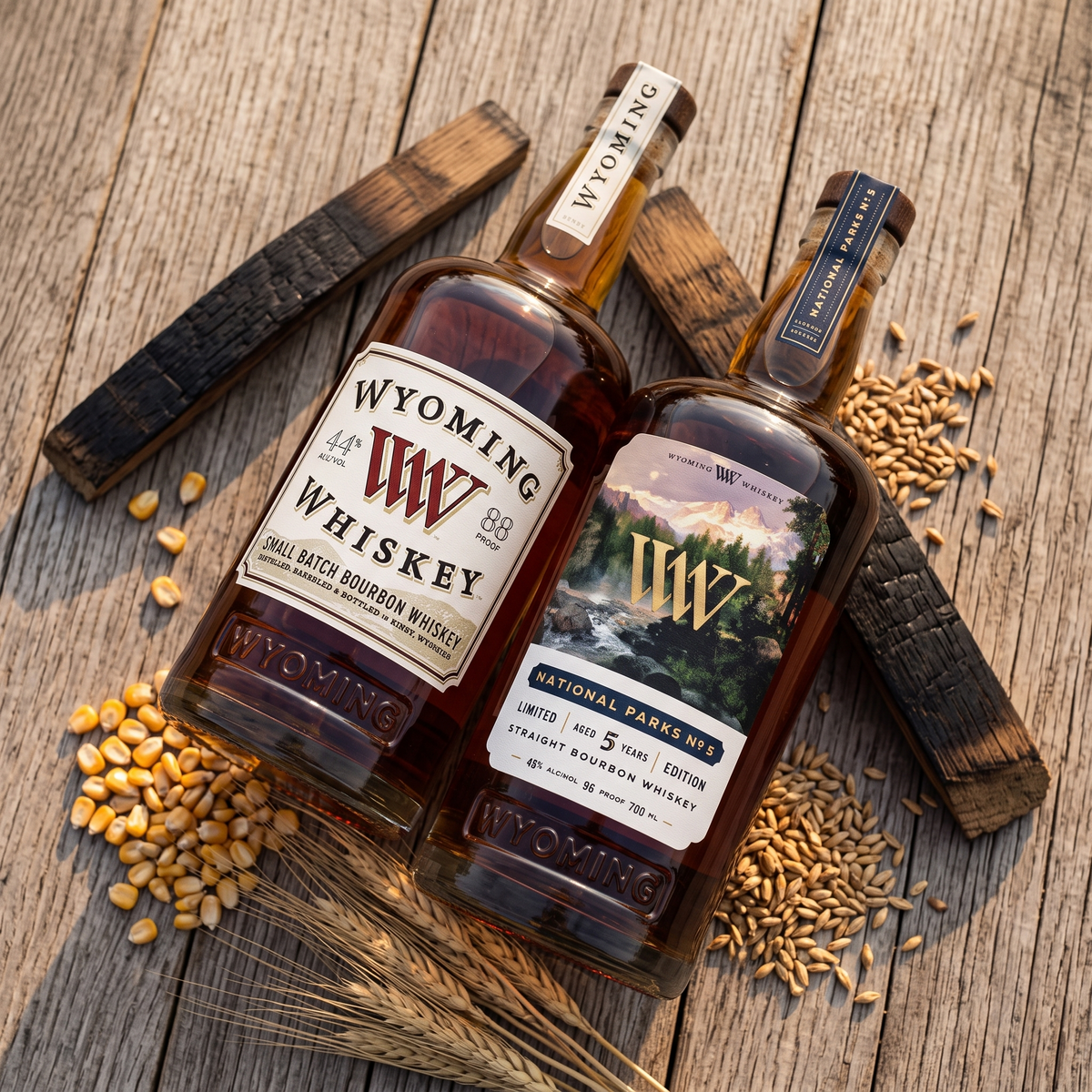
Wyoming Whiskey Small Batch — the wheated flagship, five years old, 88 proof. Earthy up front with a floral edge, and a distinct brown-butter note. David confirmed we weren't imagining it: the house profile across their wheated bourbons is caramel, orange, and vanilla, and "the brown butter is definitely one of the themes you're gonna find throughout almost all of our products." It won Double Gold at the 2023 San Francisco World Spirits Competition.
Wyoming Whiskey National Parks No. 5 — five years old, 48% ABV, and the label is Thomas Moran's 1895 painting The Three Tetons, whose original hangs in the White House collection. Moran was the painter Congress dispatched west, and his canvases helped convince the country the national parks were worth creating.
In the glass it's a clear step up and a noticeable turn toward the bakery: far more orange, honey, cinnamon sugar, a fried-dough character. David's framing is that it's "an elevated small batch" — same caramel-orange-vanilla wheelhouse, but built from better barrels drawn from the warehouse's central section rather than the mild bottom or the spicy top. It's his favorite of the National Parks editions. "This one lands squarely in my wheelhouse."
Above it sits Moran, the 10-year, 110-proof companion release — stony and mineral, with red cherry fruit and an almost candied note over the familiar orange undertone. Same mash bill as everything else. Just pulled at a different time, from a different part of the warehouse.
That's the argument in three glasses: one recipe, one place, and a set of decisions about which barrels go where.

We asked David what he drinks when he isn't drinking his own. The answer was tequila — "don't threaten me with a margarita" — though the best bourbon he's ever had was a black-label Maker's Mark sold only in Japan, gifted to him by Steve Nally during the years they were waiting on their own stock to mature. "Like drinking liquid velvet."
Asked for a closing thought, he went to the thing that clearly matters most to him right now.
"It's great to be home," he said. He mentioned the Whiskey Baron Society — a low-frequency mailing list the distillery is standing up, promising advance notice on limited releases and, notably, a real reply if you write in. He answers most of that mail himself.
"Anybody who's willing to take the time to send an email and ask a question, we're gonna respond with an honest answer — not some AI-generated, non-genuine response. You'll never see AI come out of us anywhere. All the content and everything you get from us, verbal or otherwise, is gonna be a real person talking about what's going on."
For a category full of brands that talk about craft in the abstract, an hour of specifics about warehouse corners and reduction schedules is a decent proof of the claim.
There's a practical footnote to the independence story, and it's the reason a lot of people have never seen this whiskey on a shelf.
David is deliberate about staying out of the biggest national distributors. "We don't belong in a Southern House," he told us. "There's no upside for us doing that." Instead they're picking regional distributors state by state — which is the right call for a company their size, and also means availability is uneven on purpose. He's candid that the open question for a brand named after Wyoming is "what makes us relevant in Florida? What makes us relevant in California?"
So if you've never run across it, that's the distribution model working as designed. These are the ones we carry:
And if what stuck with you here was the idea that the good stuff is decided barrel by barrel — that somebody has to walk a warehouse and taste their way to the honey spot — that's the entire premise of our Bourbon-of-the-Month Club. Wyoming Whiskey was June's feature. There's a different distillery, and a different story, every month.
Where is the Wyoming Whiskey distillery?
In Kirby, Wyoming — a small town in the Bighorn Basin, at roughly 4,200 feet on the high plains. It was the first legal distillery in the state, with production commencing on July 4, 2009.
Is Wyoming Whiskey a wheated bourbon?
Yes. The mash bill is 68% corn, 20% winter wheat, and 12% barley — wheat rather than rye as the secondary grain, which is why it drinks softer and sweeter. Outryder, the bourbon-rye blend, is the sole exception in the lineup.
How old is Wyoming Whiskey?
Everything leaving the distillery is at least five years old, and the company expects that to increase over time. National Parks No. 5 is five years; the Moran release is 10.
Why does whiskey stop aging in a Wyoming winter?
Whiskey matures by moving in and out of the charred oak as the barrel expands in heat and contracts in cold. Below roughly 40°F that movement effectively stops. Wyoming winters run five to six months, so about half the year contributes very little maturation — one reason a five-year minimum matters more here than it would in Kentucky.
What does "small batch" mean at Wyoming Whiskey?
A batch of roughly 50 to 55 barrels, assembled from three deliberate layers of the warehouse: 25–35 barrels from the cooler bottom for the base, about 10 from the middle for depth, and 3–5 from the hot top for spice.
What does "doesn't drink to proof" mean?
It's co-founder David DeFazio's claim that Wyoming Whiskey drinks softer than its stated proof would suggest — that a 125-proof Barrel Strength pour reads more like 110. He credits the distillery's slow reduction (bringing proof down over several days rather than adding all the dilution water at once) and suspects Wyoming's extreme cold plays a part, while being explicit that the second half is a hunch without evidence behind it. Worth tasting and judging yourself.
Where can I buy Wyoming Whiskey?
Availability varies by state — the distillery works with regional distributors rather than the largest national houses, so plenty of markets don't carry it. We carry the Small Batch, National Parks No. 5, and Double Cask; stock varies, so check the product page.
Read next: Wyoming Whiskey, decoded — the terroir question in American whiskey. This piece covered how they make it; that one asks whether the place itself shows up in the glass.
Interview conducted June 2026 and lightly edited for length and clarity. Additional detail from Wyoming Whiskey (Made of Wyoming — Our Process; National Parks No. 5); Breaking Bourbon; The Spirits Educator. Small Batch: Double Gold, 2023 San Francisco World Spirits Competition.