Your Cart is Empty
From The Long Pour. Background for our Buzzard's Roost interview. We sell the Buzzard's Roost bottle linked below, and nobody paid for this piece.
A new bourbon barrel can meet heat twice before it holds any whiskey. The first round is slow and low, and it's called toasting. The second is under a minute of open flame, and it's called charring. The law requires only the char, and it doesn't make the label name either one.
In this piece: Charring · The char numbers · Toasting · Toast vs char, measured · Second barrels · FAQ
Charring sets the inside of the barrel alight for a short, very hot burst. It leaves two layers behind. On top is the char itself, a layer of black charcoal. Under it is what coopers call the red layer, wood that's been cooked without burning.
The two do different jobs. The black layer adds surprisingly little flavor, since the wood there is broken down too far. The aromatics build in the red layer underneath, which also helps the whiskey pick up its color.
The char works mostly as a filter. Andrew Wiehebrink, who directs spirit research at Independent Stave Company (ISC), a barrel maker with cooperages in Kentucky and Missouri, calls it "an exceptional filter," since it's essentially a layer of carbon.
Bourbon can't skip this step. By law it has to be stored in charred new oak barrels. How heavy that char is, the law leaves open.
Coopers grade char on a scale of 1 to 4, and the grade is mostly a matter of how long the flame runs. Jason Brauner, co-founder of Buzzard's Roost, put rough times on the ends of the scale when we spoke: a Char #1 is "about a 15-second char," a Char #4 "about a 55-second char." Those are one practitioner's rough numbers.
A Char #4 is sometimes called alligator char. The heavy burn cracks the charcoal into a pattern that looks like alligator skin.
The numbered system is fairly young. It only dates to the 1950s. Before that, buyers ordered char by depth: an 1826 letter, now at the Filson Historical Society, asks for a barrel "charred to a 16th of an inch."
Heavy char is still the norm. As of 2021, the heavier charred barrel was the most popular one ISC makes, and Wiehebrink says there "isn't one definitive answer" for why Char #3 and #4 became the standard.
When a barrel gets both, toasting comes first, and it's the other kind of heat: slow instead of fast. The barrel is heated to set temperatures for up to 60 minutes, which slowly breaks the oak down into smaller compounds. The heat also reaches deeper into the stave than a char does.
The low heat is the point. Most of oak's flavor compounds break down at relatively low temperatures, so a long, low toast builds more of them than a fast, hot char does. Four of them, and what they taste like:
| Compound | What it tastes like | Source |
|---|---|---|
| Vanillin | vanilla | ISC names it; Brauner gives the vanilla |
| Furfural | "toasty, caramelized flavors" | ISC |
| Eugenol family | "spicy aromas" | ISC; Brauner names cinnamon, nutmeg, clove, and allspice |
| Guaiacol | smoke | Buzzard's Roost lists it among the compounds its barrels are built to extract; Brauner gives the smoke |
A barrel can get a toast and a char, or the char alone. ISC tested what that difference does.
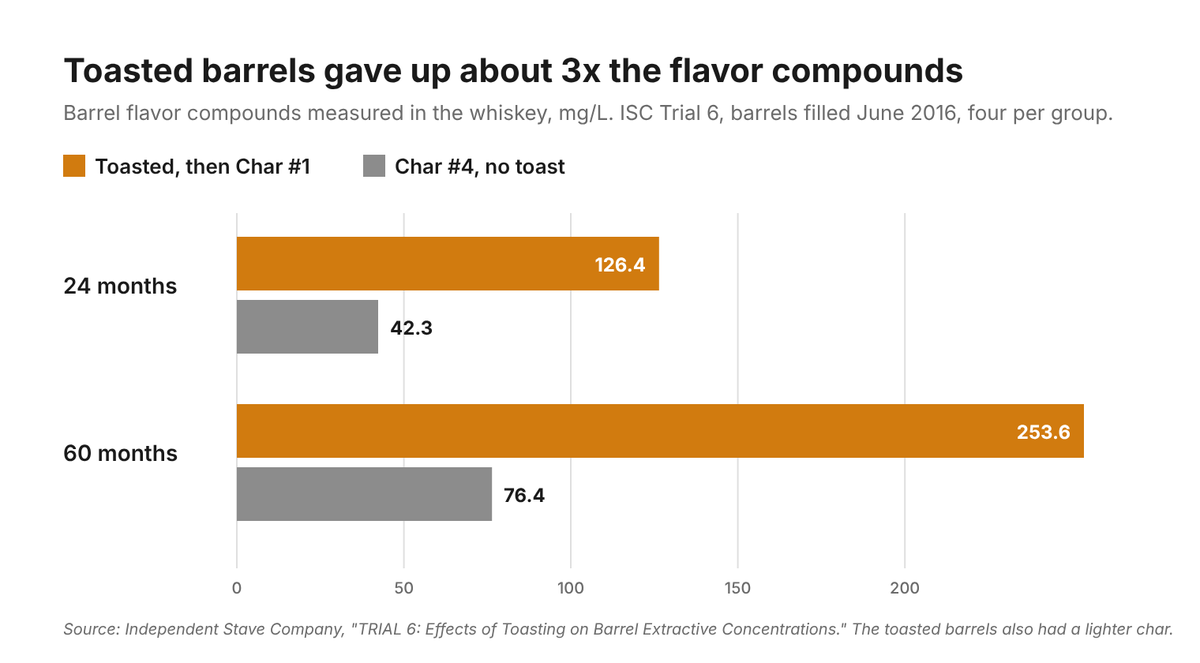
ISC filled barrels in June 2016 to put the two side by side, then measured the flavor compounds the whiskey had pulled out of the wood. One group was toasted (a profile ISC calls Traditional Medium Plus) and given a Char #1. The other was a standard Char #4 with no toast.
| Flavor compounds measured | Toasted, Char #1 | Char #4, no toast |
|---|---|---|
| At 24 months | 126.4 mg/L | 42.3 mg/L |
| At 60 months | 253.6 mg/L | 76.4 mg/L |

Chart: PourMore, from ISC's published Trial 6 figures. The toasted barrels also had the lighter char.
That's roughly three times as much at both points, and the toasted barrels held their flavor profile for at least 60 months.
The toasted barrels also had the lighter char, so the trial compares toast plus a light char against a heavy char alone. It can't say how much of the gap comes from the toast. And it's a barrel maker testing its own barrels, four per group.
Double-barreled bourbon goes into a second new barrel after the first, and that's where ISC recommends going light. Wiehebrink puts a number on it. For double-barreled bourbon, ISC recommends a light char "in 95% of the double barrel applications," with a toast added if the whiskey needs more from the wood.
His reasoning is about the filter. Whiskey going into a second barrel already has flavor from its first one, and "some flavor compounds that were brought into solution during primary maturation can be diminished when introduced to a fresh layer of char." In one ISC experiment, a Char #1 barrel held more wood extractives than a Char #4 after 12 months.
Buzzard's Roost goes light on every second barrel. Brauner told us each one gets a heavy toast and then a Char #1. He explains it with a grill: you don't sauce raw chicken and put it over the flame, because the sugar burns before the chicken is done. Their Signature Double Oak is the everyday example, and the full conversation is in our Buzzard's Roost piece.

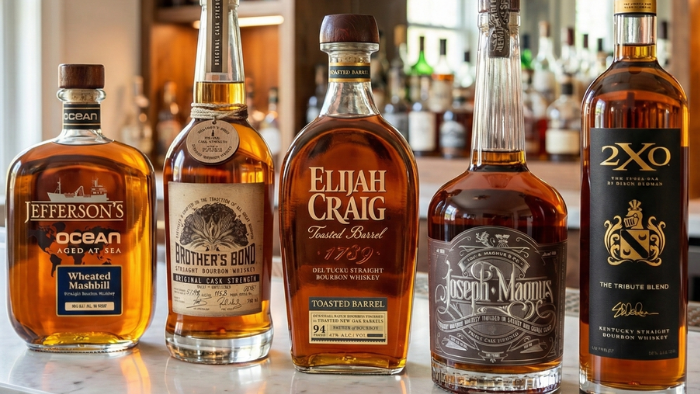
Staged image: an AI-generated scene built from a photo of the real bottle.
Not every blender agrees. 2XO, which we covered in October, sends some of its whiskey into Char #3 and #4 second barrels on purpose. A Char #3 second barrel brings "a lot more red fruit, bigger spice, a lot longer finish," Dixon Dedman told us in our 2XO bourbon interview.
A barrel whose staves were heated slowly, at relatively low temperatures, for up to an hour before any charring. Toasting breaks down the wood into flavor compounds like vanillin and furfural through a deeper layer of the stave than charring reaches.
Toasting is slow, low heat that cooks the wood and builds flavor compounds. Charring is under a minute of open flame. It leaves a layer of charcoal, which filters the whiskey, over a cooked red layer that adds aroma and color. A barrel can get both, toast first, or the char alone. Bourbon law requires only the char.
A 1-to-4 scale for how heavily a barrel's inside is burned, set mostly by how long the flame runs. Brauner of Buzzard's Roost puts a Char #1 at about 15 seconds and a Char #4 at about 55. Char #3 and #4 are the most common for bourbon.
Another name for a Char #4. The long burn cracks the charcoal into a pattern like alligator skin.
Federal rules require bourbon to be stored in charred new oak barrels. The rules don't set a char level, so a Char #1 qualifies.