Your Cart is Empty
From The Long Pour. Based on a live interview with Jason Brauner, co-founder of Buzzard's Roost, recorded November 6, 2026, and on the three Buzzard's Roost bottles our Bourbon-of-the-Month and Whiskey-of-the-Month Clubs shipped in October. We buy the bottles we ship, and we weren't paid for this piece.
Ask Jason Brauner why his barrels get so little fire and he talks about chicken.
"You don't take raw chicken, smear it with barbecue sauce, and throw it on the grill, right?" he said. "Because the sugars in your sauce are gonna burn before your chicken's ever done."
That's the whole theory of Buzzard's Roost in one backyard image. Brauner came to whiskey through the restaurant business, about 20 years of it by his count, and he still thinks like a cook. Every Buzzard's Roost whiskey spends time in a second barrel the company designed. The house standard for that barrel is a heavy toast and then a Char 1, the lightest of the standard char levels, so the sugars the toast brings up don't get burned back off.
Our clubs shipped three of their bottles in October. We got Brauner on a call from the Louisville tasting room to explain how they're built.
In this piece: Who Buzzard's Roost is · Toast hard, char light · Seventeen barrels and a spice rack · How long the second barrel takes · Two cigar whiskeys, built two ways · The corduroy barrel · The pour · FAQ
Brauner and Judy Hollis Jones founded Buzzard's Roost in 2019. On the call he split the work this way: she came out of corporate life and runs the company side, and he runs the whiskey. He opened Bourbons Bistro in Louisville and, by his count, picked probably more than a hundred single barrels for it, which is how he ended up in so many warehouses tasting other people's whiskey and thinking he could do this himself.
The first plan was a full distillery on a farm they had surveyed in Waddy, Kentucky. An investor walked away, and Brauner says they ended up "about thirty million dollars short." So they did what a lot of small brands do and bought aged whiskey instead, starting with three barrels: two blended into a small batch, and one single barrel.
He is plain about where the whiskey comes from. Most of the aged stock is from MGP in Indiana, he said. Bardstown Bourbon Company does the contract work, re-barrels everything and keeps aging it, and they do a little work with Green River. The back labels on our two cigar bottles say the same thing in fewer words: "Distilled in Indiana," bottled in Bardstown. (We've made the case for sourced whiskey before.) His own line on it: "We're not taking bad whiskey and making it better. We take good or great whiskey, and we think we make it better. If you've got some bad whiskey, I can't help your whiskey with my barrels."
The name came off that lost farm. The road along one edge was Buzzard Roost Road. Brauner also wanted something that sounded a hundred years old without reviving a dead label, and the name stuck. The tasting room on Whiskey Row opened in April 2023. He says they now have new make, the unaged spirit, headed for their own Char 1 barrels.
A barrel like this goes through fire twice when it's made. First the staves are toasted, heated slowly from a distance so the wood cooks without catching. Then the inside is charred, set alight for a short burst that leaves a black layer. Cooperages number the char, and Brauner put rough times on them: a Char 1 is "about a 15-second char," a Char 4 "about a 55-second char." In his experience most of the whiskey he tasted through the warehouses came out of Char 3 or Char 4.
Buzzard's Roost goes the other way. Independent Stave Company builds its second barrels to the brand's spec, Brauner said, from new American oak seasoned for 18 months. They get toasted to set profiles and then a Char 1, "exclusively." Toasting brings the wood's sugars up toward the surface, he explained, and a deep char would burn them back off.
The char stays for two reasons, by his account. Bourbon has to be stored in charred new oak barrels, so a char keeps it legal, and even a Char 1 still filters the whiskey through some charcoal. Past that, he wants the flavor that sits "just under that charred layer" left intact.
Their original small batch was simply called Char 1. "We wanted to be the first to say we use a char one," he said, because the bourbon industry's messaging, as he put it, "gets convoluted."

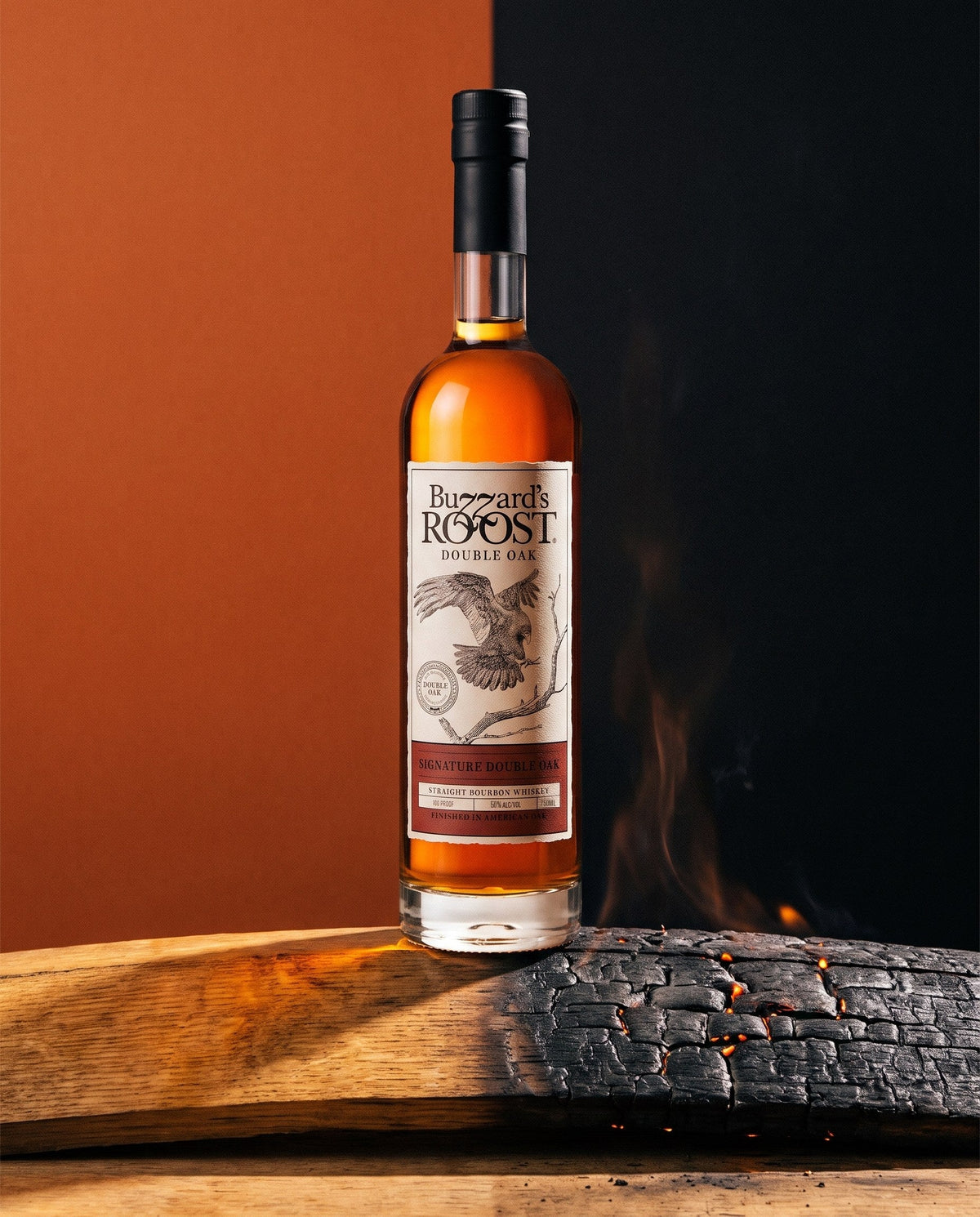
Staged image: an AI-generated scene built from a photo of the real bottle.
Buzzard's Roost has developed 17 proprietary barrel profiles. Each, Brauner said, is brand-new cooperage from Independent Stave, used once. They differ in how the toast is run, by time and temperature, so each pulls a different set of compounds out of the wood. He reads them the way a lab would, as parts per million on charts from a gas chromatograph, and named the four families he looks for:
| Compound | What he tastes |
|---|---|
| Vanillin | vanilla, "the cream soda type thing" |
| Eugenol | baking spice: cinnamon, nutmeg, clove, allspice |
| Furfural and 5-hydroxymethylfurfural | butterscotch, almond, buttered popcorn |
| Guaiacol | the smoky end: campfire, burnt sugar, leather, bacon |
"My barrels range anywhere from sweet to smoky to spicy," he said. He calls the set his spice rack. Since "you get 70% of the flavor from the barrel," as he put it, the rack is how a sourced whiskey ends up tasting like what he calls "Buzzard Juice," whoever distilled it.
Ahead of the call, Buzzard's Roost sent us a Bottled in Bond, which wasn't among the October bottles. It's a 45% wheat bourbon, and Brauner expected that much wheat to drink "sweet and unappealing" to him. So it went into barrels from the smoky, spicy end of the rack. We found honey on the nose without the sweetness, some blood orange and baking spice. Brauner got honeysuckle, like the flowers he tasted as a kid: "You could taste it, but it was never enough."
The company started with rye, which is funny coming from a man who says, "I hated rye when I started the company." The base was a young MGP rye, 95% rye and 5% malted barley, bottled at 105 proof and put in the sweeter barrels. He calls the results "bourbon drinker's ryes."
"It could be in there two months," Brauner said of the second barrel. "It could be in there three years." He thinks the two cigar bottles averaged about six months.
Rye moves fastest, he said: it picks up flavor from the barrel quicker than bourbon, and a wheated bourbon takes longer.

Staged image: an AI-generated scene built from a photo of the real bottle.
The two cigar whiskeys we shipped get their smoke by different routes.
The Cigar Blend Bourbon has no tobacco anywhere in it. The label says so: "This product does not contain any tobacco or nicotine." Its smoke comes from barrel choice. For the second aging, the bourbon goes into lightly charred, heavily toasted barrels, and on the call Brauner said the smoke is drawn from the guaiacol end of his toast profiles. The new release is seven years old and 105 proof.
The Cigar Rye does use tobacco. Its new, lightly charred barrels are toasted and then cold-smoked with aged Kentucky tobacco leaves. The back label puts it more gently: "very lightly smoked." Our bottles are Batch 3, 95% rye, 105 proof, with the bottle number written on the label by hand.

Staged image: an AI-generated scene built from a photo of the real bottle.
Then we tasted them, and the tobacco turned up in the bourbon.
Our notes on the Cigar Blend: red stone fruit, dates, spiced pecan, and a tobacco note sitting right on top, darker all round than the rye. Brauner passed along how someone once described it to him: "putting a cigar in your mouth right before you light it." He called it "the Cab as opposed to the Merlot we had earlier." A little ice, or a drop of water, may bring the smoke up further, he said.
On the Cigar Rye, we got pumpernickel, a bready nose, hickory, a smoky outdoor smell, and a lot of spice. We got no tobacco on it, at least not the way it showed in the bourbon. Brauner's read is that the rye itself does it: with a 95% rye mash bill, "you're gonna get that spice out of there, and that may overshadow" the smoke. His word for it was campfire.
Asked to pick a favorite between them, Brauner leaned Cigar Blend. Ours was the rye.
The strangest barrel he told us about went into a release called Kindred. For it, Brauner said, Buzzard's Roost cut grooves into the inside of the staves before toasting and charring, until the wood "almost looks like a pair of corduroy pants." He puts the extra surface area at about 30%, and the ridges and the troughs toast and char differently, which makes it, in his words, "a great balancing barrel."
Kindred came out of about eight barrels that spent six to eight months in the grooved wood, he thinks. We bought one of the last bottles at the distillery on a visit in spring 2025 and opened it for the call. It tasted controlled to us, every flavor there but nothing turned all the way up. Brauner's version: "a little more delicate than bold, but it's not delicate either." He thinks the barrel is coming back.
| Bottle | Club and tier | Proof | The second barrel |
|---|---|---|---|
| Signature Double Oak Bourbon | Bourbon · Intro | 100 | Proprietary toasted, lightly charred cask (label: "specially cured, toasted & charred oak") |
| Cigar Blend Bourbon | Bourbon · Explorer | 105 | Lightly charred, heavily toasted barrels picked for smoke; no tobacco |
| Cigar Rye, Batch 3 | Whiskey · Explorer | 105 | New oak, toasted and lightly smoked with Kentucky cigar tobacco |
We didn't pour the Signature on the call, so these are Buzzard's Roost's own tasting notes for Signature: cinnamon and roasted nuts on the nose, vanilla and roasted almond with gentle spice on the palate, and a long, warm cinnamon finish. It's a 21% rye straight bourbon at 100 proof, the everyday bottle of the range. Brauner says they try to keep prices under $100.
For a last word, Brauner sent people to the building. The tasting room is at 624 West Main, he said, "right in the heart of the big boys" on Whiskey Row, and if you don't see the bottles where you live, ask your local store: "It's all grassroots."
Our Bourbon club ships a different distillery's bottle every month.
Buzzard's Roost Spirits of Louisville, Kentucky, founded in 2019 by Jason Brauner and Judy Hollis Jones. It buys aged whiskey, mostly distilled in Indiana, and ages it again in second barrels of its own design. Brauner told us Independent Stave Company builds them.
Every Buzzard's Roost whiskey ages first in a new charred oak barrel and then in a second new barrel of the company's own design. The house standard for those second barrels is a heavy toast and a light Char 1.
The lightest of the standard char levels. Brauner described it as about 15 seconds of flame, against about 55 seconds for a Char 4. By his account, Buzzard's Roost uses it so the char doesn't burn off the sugars that toasting brings to the surface of the wood.
It doesn't. The label states it contains no tobacco or nicotine. The smoky character comes from the barrels chosen for its second aging.
Yes, in the barrel. Its back label says the second barrels were toasted and then very lightly smoked with Kentucky aged cigar tobacco.
The Buzzard's Roost Distillery and Tasting Room is at 624 West Main Street in downtown Louisville, on Whiskey Row. It opened in April 2023.